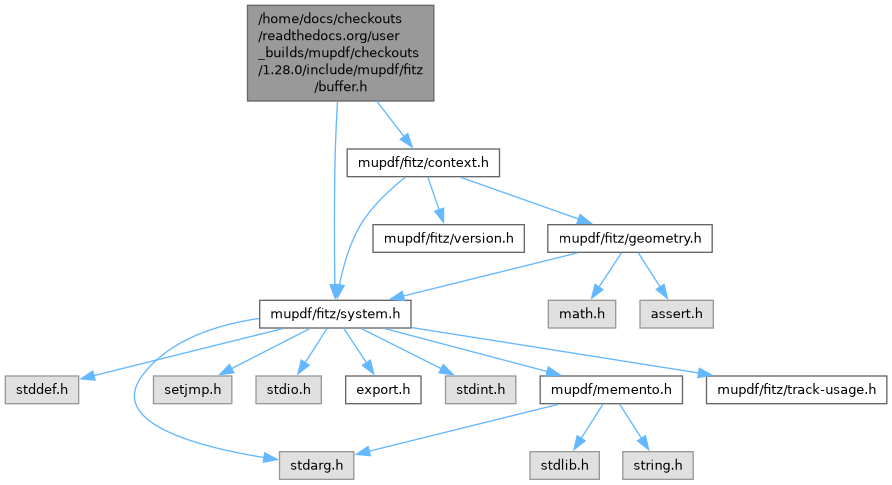
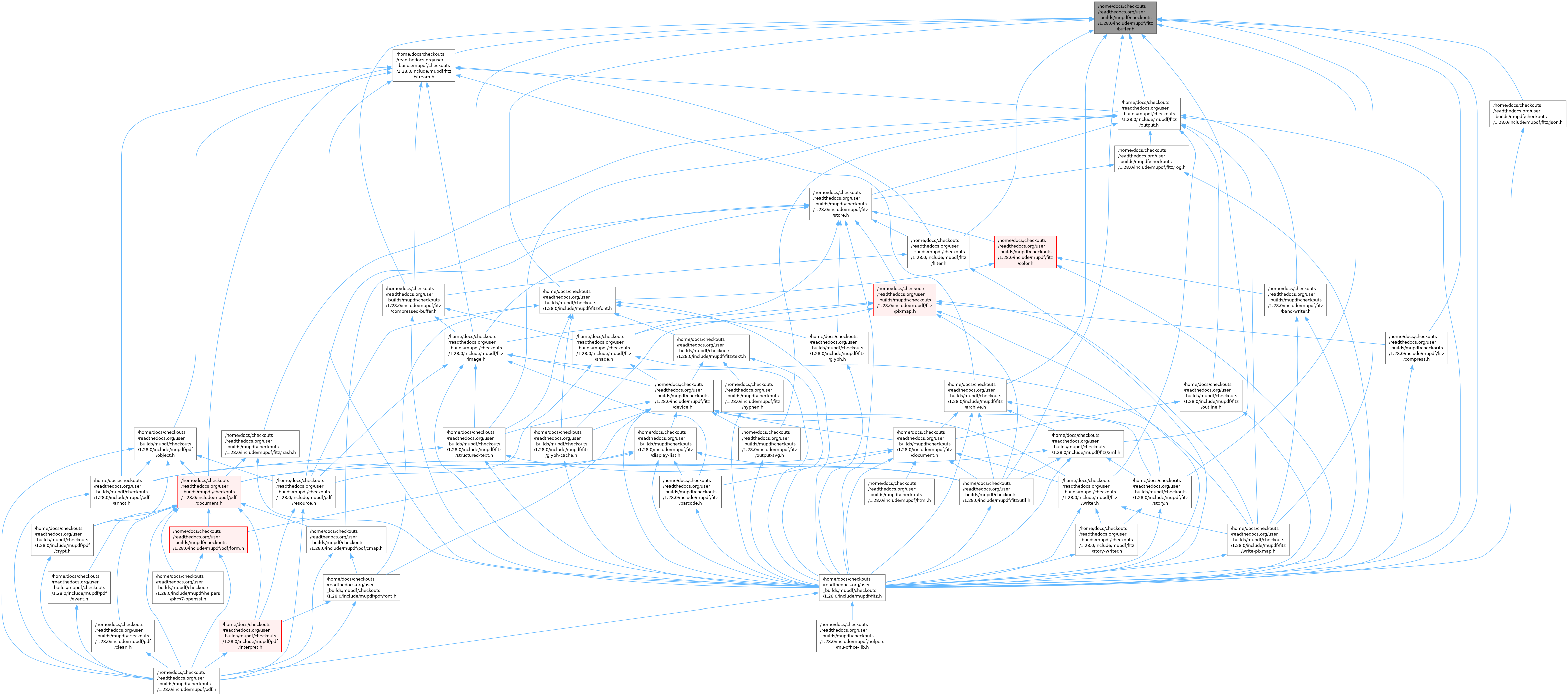
Go to the source code of this file.
Classes | |
| struct | fz_buffer |
Function Documentation
◆ fz_append_base64()
| void fz_append_base64 | ( | fz_context * | ctx, |
| fz_buffer * | out, | ||
| const unsigned char * | data, | ||
| size_t | size, | ||
| int | newline ) |
Write a base64 encoded data block, optionally with periodic newlines.
◆ fz_append_base64_buffer()
| void fz_append_base64_buffer | ( | fz_context * | ctx, |
| fz_buffer * | out, | ||
| fz_buffer * | data, | ||
| int | newline ) |
Append a base64 encoded fz_buffer, optionally with periodic newlines.
◆ fz_append_bits()
| void fz_append_bits | ( | fz_context * | ctx, |
| fz_buffer * | buf, | ||
| int | value, | ||
| int | count ) |
◆ fz_append_bits_pad()
| void fz_append_bits_pad | ( | fz_context * | ctx, |
| fz_buffer * | buf ) |
◆ fz_append_buffer()
| void fz_append_buffer | ( | fz_context * | ctx, |
| fz_buffer * | destination, | ||
| fz_buffer * | source ) |
Append the contents of the source buffer onto the end of the destination buffer, extending automatically as required.
Ownership of buffers does not change.
◆ fz_append_byte()
| void fz_append_byte | ( | fz_context * | ctx, |
| fz_buffer * | buf, | ||
| int | c ) |
◆ fz_append_data()
| void fz_append_data | ( | fz_context * | ctx, |
| fz_buffer * | buf, | ||
| const void * | data, | ||
| size_t | len ) |
fz_append_*: Append data to a buffer.
The buffer will automatically grow as required.
◆ fz_append_int16_be()
| void fz_append_int16_be | ( | fz_context * | ctx, |
| fz_buffer * | buf, | ||
| int16_t | x ) |
◆ fz_append_int16_le()
| void fz_append_int16_le | ( | fz_context * | ctx, |
| fz_buffer * | buf, | ||
| int16_t | x ) |
◆ fz_append_int32_be()
| void fz_append_int32_be | ( | fz_context * | ctx, |
| fz_buffer * | buf, | ||
| int32_t | x ) |
◆ fz_append_int32_le()
| void fz_append_int32_le | ( | fz_context * | ctx, |
| fz_buffer * | buf, | ||
| int32_t | x ) |
◆ fz_append_pdf_string()
| void fz_append_pdf_string | ( | fz_context * | ctx, |
| fz_buffer * | buffer, | ||
| const char * | text ) |
fz_append_pdf_string: Append a string with PDF syntax quotes and escapes.
The buffer will automatically grow as required.
◆ fz_append_printf()
| void fz_append_printf | ( | fz_context * | ctx, |
| fz_buffer * | buffer, | ||
| const char * | fmt, | ||
| ... ) |
fz_append_printf: Format and append data to buffer using printf-like formatting (see fz_vsnprintf).
The buffer will automatically grow as required.
◆ fz_append_rune()
| void fz_append_rune | ( | fz_context * | ctx, |
| fz_buffer * | buf, | ||
| int | c ) |
◆ fz_append_string()
| void fz_append_string | ( | fz_context * | ctx, |
| fz_buffer * | buf, | ||
| const char * | data ) |
◆ fz_append_uint16_be()
| void fz_append_uint16_be | ( | fz_context * | ctx, |
| fz_buffer * | buf, | ||
| uint16_t | x ) |
◆ fz_append_uint16_le()
| void fz_append_uint16_le | ( | fz_context * | ctx, |
| fz_buffer * | buf, | ||
| uint16_t | x ) |
◆ fz_append_uint32_be()
| void fz_append_uint32_be | ( | fz_context * | ctx, |
| fz_buffer * | buf, | ||
| uint32_t | x ) |
◆ fz_append_uint32_le()
| void fz_append_uint32_le | ( | fz_context * | ctx, |
| fz_buffer * | buf, | ||
| uint32_t | x ) |
◆ fz_append_vprintf()
| void fz_append_vprintf | ( | fz_context * | ctx, |
| fz_buffer * | buffer, | ||
| const char * | fmt, | ||
| va_list | args ) |
fz_append_vprintf: Format and append data to buffer using printf-like formatting with varargs (see fz_vsnprintf).
◆ fz_buffer_extract()
| size_t fz_buffer_extract | ( | fz_context * | ctx, |
| fz_buffer * | buf, | ||
| unsigned char ** | data ) |
Take ownership of buffer contents.
Performs the same task as fz_buffer_storage, but ownership of the data buffer returns with this call. The buffer is left empty.
Note: Bad things may happen if this is called on a buffer with multiple references that is being used from multiple threads.
data: Pointer to place to retrieve data pointer.
Returns length of stream.
◆ fz_buffer_storage()
| size_t fz_buffer_storage | ( | fz_context * | ctx, |
| fz_buffer * | buf, | ||
| unsigned char ** | datap ) |
Retrieve internal memory of buffer.
datap: Output parameter that will be pointed to the data.
Returns the current size of the data in bytes.
◆ fz_clear_buffer()
| void fz_clear_buffer | ( | fz_context * | ctx, |
| fz_buffer * | buf ) |
Empties the buffer. Storage is not freed, but is held ready to be reused as the buffer is refilled.
Never throws exceptions.
◆ fz_clone_buffer()
| fz_buffer * fz_clone_buffer | ( | fz_context * | ctx, |
| fz_buffer * | buf ) |
Make a new buffer, containing a copy of the data used in the original.
◆ fz_drop_buffer()
| void fz_drop_buffer | ( | fz_context * | ctx, |
| fz_buffer * | buf ) |
Drop a reference to the buffer. When the reference count reaches zero, the buffer is destroyed.
Never throws exceptions.
◆ fz_grow_buffer()
| void fz_grow_buffer | ( | fz_context * | ctx, |
| fz_buffer * | buf ) |
Make some space within a buffer (i.e. ensure that capacity > size).
◆ fz_keep_buffer()
| fz_buffer * fz_keep_buffer | ( | fz_context * | ctx, |
| fz_buffer * | buf ) |
Take an additional reference to the buffer. The same pointer is returned.
Never throws exceptions.
◆ fz_md5_buffer()
| void fz_md5_buffer | ( | fz_context * | ctx, |
| fz_buffer * | buffer, | ||
| unsigned char | digest[16] ) |
Create an MD5 digest from buffer contents.
Never throws exceptions.
◆ fz_new_buffer()
| fz_buffer * fz_new_buffer | ( | fz_context * | ctx, |
| size_t | capacity ) |
◆ fz_new_buffer_from_base64()
| fz_buffer * fz_new_buffer_from_base64 | ( | fz_context * | ctx, |
| const char * | data, | ||
| size_t | size ) |
Create a new buffer with data decoded from a base64 input string.
◆ fz_new_buffer_from_copied_data()
| fz_buffer * fz_new_buffer_from_copied_data | ( | fz_context * | ctx, |
| const unsigned char * | data, | ||
| size_t | size ) |
Create a new buffer containing a copy of the passed data.
◆ fz_new_buffer_from_data()
| fz_buffer * fz_new_buffer_from_data | ( | fz_context * | ctx, |
| unsigned char * | data, | ||
| size_t | size ) |
Create a new buffer with existing data.
data: Pointer to existing data. size: Size of existing data.
Takes ownership of data. Does not make a copy. Calls fz_free on the data when the buffer is deallocated. Do not use 'data' after passing to this function.
Returns pointer to new buffer. Throws exception on allocation failure.
◆ fz_new_buffer_from_printf()
| fz_buffer * fz_new_buffer_from_printf | ( | fz_context * | ctx, |
| const char * | fmt, | ||
| ... ) |
Create a new buffer with printf formatted data.
◆ fz_new_buffer_from_shared_data()
| fz_buffer * fz_new_buffer_from_shared_data | ( | fz_context * | ctx, |
| const unsigned char * | data, | ||
| size_t | size ) |
Like fz_new_buffer, but does not take ownership.
◆ fz_resize_buffer()
| void fz_resize_buffer | ( | fz_context * | ctx, |
| fz_buffer * | buf, | ||
| size_t | capacity ) |
Ensure that a buffer has a given capacity, truncating data if required.
capacity: The desired capacity for the buffer. If the current size of the buffer contents is smaller than capacity, it is truncated.
◆ fz_slice_buffer()
| fz_buffer * fz_slice_buffer | ( | fz_context * | ctx, |
| fz_buffer * | buf, | ||
| int64_t | start, | ||
| int64_t | end ) |
Create a new buffer with a (subset of) the data from the buffer.
start: if >= 0, offset from start of buffer, if < 0 offset from end of buffer.
end: if >= 0, offset from start of buffer, if < 0 offset from end of buffer.
◆ fz_string_from_buffer()
| const char * fz_string_from_buffer | ( | fz_context * | ctx, |
| fz_buffer * | buf ) |
Ensure that a buffer's data ends in a 0 byte, and return a pointer to it.
◆ fz_terminate_buffer()
| void fz_terminate_buffer | ( | fz_context * | ctx, |
| fz_buffer * | buf ) |
Zero-terminate buffer in order to use as a C string.
This byte is invisible and does not affect the length of the buffer as returned by fz_buffer_storage. The zero byte is written after the data, and subsequent writes will overwrite the terminating byte.
Subsequent changes to the size of the buffer (such as by fz_buffer_trim, fz_buffer_grow, fz_resize_buffer, etc) may invalidate this.
◆ fz_trim_buffer()
| void fz_trim_buffer | ( | fz_context * | ctx, |
| fz_buffer * | buf ) |
Trim wasted capacity from a buffer by resizing internal memory.