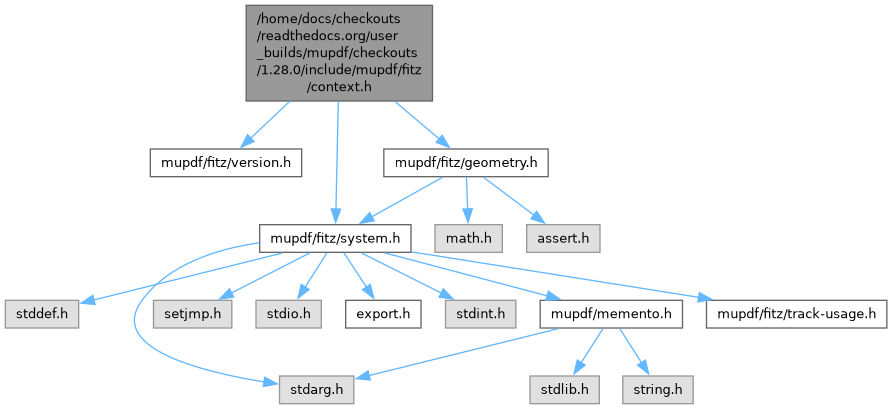
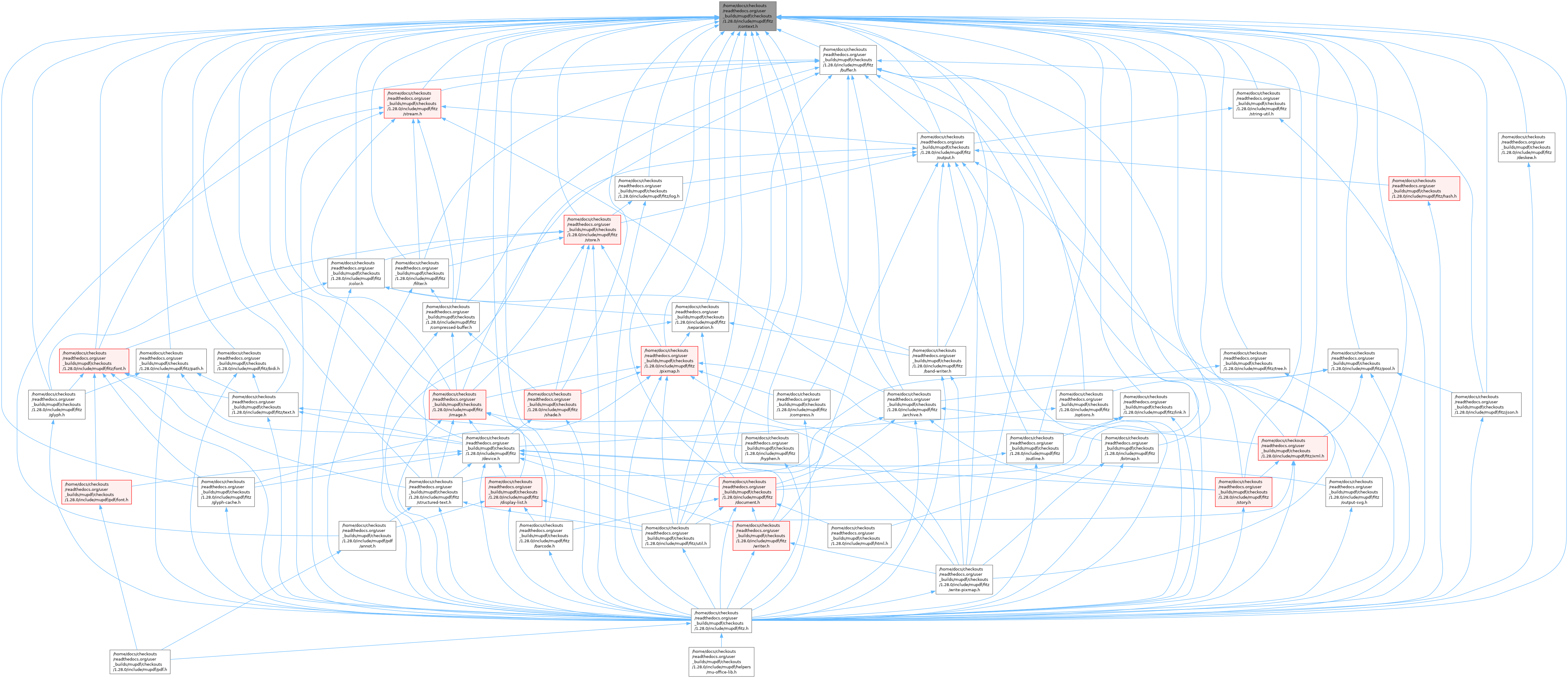
Go to the source code of this file.
Classes | |
| struct | fz_alloc_context |
| struct | fz_locks_context |
| struct | fz_string |
| struct | fz_error_stack_slot |
| struct | fz_error_context |
| struct | fz_warn_context |
| struct | fz_aa_context |
| struct | fz_activity_context |
| struct | fz_context |
Macros | |
| #define | FZ_VERBOSE_EXCEPTIONS 0 |
| #define | fz_var(var) |
| #define | fz_try(ctx) |
| #define | fz_always(ctx) |
| #define | fz_catch(ctx) |
| #define | FITZ_DEBUG_LOCKING |
| #define | fz_new_context(alloc, locks, max_store) |
| #define | fz_malloc_struct(CTX, TYPE) |
| #define | fz_malloc_struct_array(CTX, N, TYPE) |
| #define | fz_malloc_array(CTX, COUNT, TYPE) |
| #define | fz_realloc_array(CTX, OLD, COUNT, TYPE) |
| #define | fz_malloc_flexible(ctx, T, M, count) |
| #define | fz_realloc_flexible(ctx, p, T, M, count) |
| #define | fz_pool_alloc_flexible(ctx, pool, T, M, count) |
| #define | fz_sizeof_flexible(T, M, count) |
| #define | fz_cstring_from_string(A) |
| #define | FZ_JMPBUF_ALIGN 32 |
| #define | fz_keep_imp(C, P, R) |
| #define | fz_keep_imp8(C, P, R) |
| #define | fz_keep_imp16(C, P, R) |
| #define | fz_keep_imp_locked(C, P, R) |
| #define | fz_keep_imp8_locked(C, P, R) |
| #define | fz_drop_imp(C, P, R) |
| #define | fz_drop_imp8(C, P, R) |
| #define | fz_drop_imp16(C, P, R) |
Typedefs | |
| typedef struct fz_font_context | fz_font_context |
| typedef struct fz_hyph_context | fz_hyph_context |
| typedef struct fz_colorspace_context | fz_colorspace_context |
| typedef struct fz_style_context | fz_style_context |
| typedef struct fz_tuning_context | fz_tuning_context |
| typedef struct fz_store | fz_store |
| typedef struct fz_glyph_cache | fz_glyph_cache |
| typedef struct fz_document_handler_context | fz_document_handler_context |
| typedef struct fz_archive_handler_context | fz_archive_handler_context |
| typedef struct fz_output | fz_output |
| typedef struct fz_context | fz_context |
| typedef void | fz_error_cb(void *user, const char *message) |
| typedef void | fz_warning_cb(void *user, const char *message) |
| typedef void | fz_tune_image_decode_fn(void *arg, int w, int h, int l2factor, fz_irect *subarea) |
| typedef int | fz_tune_image_scale_fn(void *arg, int dst_w, int dst_h, int src_w, int src_h) |
| typedef void | fz_activity_fn(fz_context *ctx, void *opaque, fz_activity_reason reason, void *reason_arg) |
Enumerations | |
| enum | fz_error_type { FZ_ERROR_NONE , FZ_ERROR_GENERIC , FZ_ERROR_SYSTEM , FZ_ERROR_LIBRARY , FZ_ERROR_ARGUMENT , FZ_ERROR_LIMIT , FZ_ERROR_UNSUPPORTED , FZ_ERROR_FORMAT , FZ_ERROR_SYNTAX , FZ_ERROR_TRYLATER , FZ_ERROR_ABORT , FZ_ERROR_REPAIRED } |
| enum | { FZ_LOCK_ALLOC = 0 , FZ_LOCK_FREETYPE , FZ_LOCK_GLYPHCACHE , FZ_LOCK_MAX } |
| enum | { FZ_STORE_UNLIMITED = 0 , FZ_STORE_DEFAULT = 256 << 20 } |
| enum | { FZ_IMAGE_RENDERING_BALANCE = 0 , FZ_IMAGE_RENDERING_QUALITY = 1 , FZ_IMAGE_RENDERING_SPEED = 2 } |
| enum | fz_activity_reason { FZ_ACTIVITY_NEW_DOC = 0 , FZ_ACTIVITY_SHUTDOWN = 1 } |
Macro Definition Documentation
◆ FITZ_DEBUG_LOCKING
| #define FITZ_DEBUG_LOCKING |
◆ fz_always
| #define fz_always | ( | ctx | ) |
◆ fz_catch
| #define fz_catch | ( | ctx | ) |
◆ fz_cstring_from_string
| #define fz_cstring_from_string | ( | A | ) |
◆ fz_drop_imp
| #define fz_drop_imp | ( | C, | |
| P, | |||
| R ) |
◆ fz_drop_imp16
| #define fz_drop_imp16 | ( | C, | |
| P, | |||
| R ) |
◆ fz_drop_imp8
| #define fz_drop_imp8 | ( | C, | |
| P, | |||
| R ) |
◆ FZ_JMPBUF_ALIGN
| #define FZ_JMPBUF_ALIGN 32 |
◆ fz_keep_imp
| #define fz_keep_imp | ( | C, | |
| P, | |||
| R ) |
◆ fz_keep_imp16
| #define fz_keep_imp16 | ( | C, | |
| P, | |||
| R ) |
◆ fz_keep_imp8
| #define fz_keep_imp8 | ( | C, | |
| P, | |||
| R ) |
◆ fz_keep_imp8_locked
| #define fz_keep_imp8_locked | ( | C, | |
| P, | |||
| R ) |
◆ fz_keep_imp_locked
| #define fz_keep_imp_locked | ( | C, | |
| P, | |||
| R ) |
◆ fz_malloc_array
| #define fz_malloc_array | ( | CTX, | |
| COUNT, | |||
| TYPE ) |
Allocate uninitialized memory for an array of structures, and tag the pointer for Memento. Does NOT clear the memory!
Throws exception in the event of failure to allocate.
◆ fz_malloc_flexible
| #define fz_malloc_flexible | ( | ctx, | |
| T, | |||
| M, | |||
| count ) |
Flexible array member allocation helpers.
◆ fz_malloc_struct
| #define fz_malloc_struct | ( | CTX, | |
| TYPE ) |
Memory Allocation and Scavenging:
All calls to MuPDF's allocator functions pass through to the underlying allocators passed in when the initial context is created, after locks are taken (using the supplied locking function) to ensure that only one thread at a time calls through.
If the underlying allocator fails, MuPDF attempts to make room for the allocation by evicting elements from the store, then retrying.
Any call to allocate may then result in several calls to the underlying allocator, and result in elements that are only referred to by the store being freed. Allocate memory for a structure, clear it, and tag the pointer for Memento.
Throws exception in the event of failure to allocate.
◆ fz_malloc_struct_array
| #define fz_malloc_struct_array | ( | CTX, | |
| N, | |||
| TYPE ) |
Allocate memory for an array of structures, clear it, and tag the pointer for Memento.
Throws exception in the event of failure to allocate.
◆ fz_new_context
| #define fz_new_context | ( | alloc, | |
| locks, | |||
| max_store ) |
Allocate context containing global state.
The global state contains an exception stack, resource store, etc. Most functions in MuPDF take a context argument to be able to reference the global state. See fz_drop_context for freeing an allocated context.
alloc: Supply a custom memory allocator through a set of function pointers. Set to NULL for the standard library allocator. The context will keep the allocator pointer, so the data it points to must not be modified or freed during the lifetime of the context.
locks: Supply a set of locks and functions to lock/unlock them, intended for multi-threaded applications. Set to NULL when using MuPDF in a single-threaded applications. The context will keep the locks pointer, so the data it points to must not be modified or freed during the lifetime of the context.
max_store: Maximum size in bytes of the resource store, before it will start evicting cached resources such as fonts and images. FZ_STORE_UNLIMITED can be used if a hard limit is not desired. Use FZ_STORE_DEFAULT to get a reasonable size.
May return NULL.
◆ fz_pool_alloc_flexible
| #define fz_pool_alloc_flexible | ( | ctx, | |
| pool, | |||
| T, | |||
| M, | |||
| count ) |
◆ fz_realloc_array
| #define fz_realloc_array | ( | CTX, | |
| OLD, | |||
| COUNT, | |||
| TYPE ) |
◆ fz_realloc_flexible
| #define fz_realloc_flexible | ( | ctx, | |
| p, | |||
| T, | |||
| M, | |||
| count ) |
◆ fz_sizeof_flexible
| #define fz_sizeof_flexible | ( | T, | |
| M, | |||
| count ) |
◆ fz_try
| #define fz_try | ( | ctx | ) |
◆ fz_var
| #define fz_var | ( | var | ) |
Exception macro definitions. Just treat these as a black box - pay no attention to the man behind the curtain.
◆ FZ_VERBOSE_EXCEPTIONS
| #define FZ_VERBOSE_EXCEPTIONS 0 |
Typedef Documentation
◆ fz_activity_fn
| typedef void fz_activity_fn(fz_context *ctx, void *opaque, fz_activity_reason reason, void *reason_arg) |
◆ fz_archive_handler_context
| typedef struct fz_archive_handler_context fz_archive_handler_context |
◆ fz_colorspace_context
| typedef struct fz_colorspace_context fz_colorspace_context |
◆ fz_context
| typedef struct fz_context fz_context |
◆ fz_document_handler_context
| typedef struct fz_document_handler_context fz_document_handler_context |
◆ fz_error_cb
| typedef void fz_error_cb(void *user, const char *message) |
A callback called whenever an error message is generated. The user pointer passed to fz_set_error_callback() is passed along with the error message.
◆ fz_font_context
| typedef struct fz_font_context fz_font_context |
◆ fz_glyph_cache
| typedef struct fz_glyph_cache fz_glyph_cache |
◆ fz_hyph_context
| typedef struct fz_hyph_context fz_hyph_context |
◆ fz_output
| typedef struct fz_output fz_output |
◆ fz_store
◆ fz_style_context
| typedef struct fz_style_context fz_style_context |
◆ fz_tune_image_decode_fn
| typedef void fz_tune_image_decode_fn(void *arg, int w, int h, int l2factor, fz_irect *subarea) |
In order to tune MuPDF's behaviour, certain functions can (optionally) be provided by callers. Given the width and height of an image, the subsample factor, and the subarea of the image actually required, the caller can decide whether to decode the whole image or just a subarea.
arg: The caller supplied opaque argument.
w, h: The width/height of the complete image.
l2factor: The log2 factor for subsampling (i.e. image will be decoded to (w>>l2factor, h>>l2factor)).
subarea: The actual subarea required for the current operation. The tuning function is allowed to increase this in size if required.
◆ fz_tune_image_scale_fn
| typedef int fz_tune_image_scale_fn(void *arg, int dst_w, int dst_h, int src_w, int src_h) |
Given the source width and height of image, together with the actual required width and height, decide whether we should use mitchell scaling.
arg: The caller supplied opaque argument.
dst_w, dst_h: The actual width/height required on the target device.
src_w, src_h: The source width/height of the image.
Return 0 not to use the Mitchell scaler, 1 to use the Mitchell scaler. All other values reserved.
◆ fz_tuning_context
| typedef struct fz_tuning_context fz_tuning_context |
◆ fz_warning_cb
| typedef void fz_warning_cb(void *user, const char *message) |
A callback called whenever a warning message is generated. The user pointer passed to fz_set_warning_callback() is passed along with the warning message.
Enumeration Type Documentation
◆ anonymous enum
| anonymous enum |
◆ anonymous enum
| anonymous enum |
Specifies the maximum size in bytes of the resource store in fz_context. Given as argument to fz_new_context.
FZ_STORE_UNLIMITED: Let resource store grow unbounded.
FZ_STORE_DEFAULT: A reasonable upper bound on the size, for devices that are not memory constrained.
| Enumerator | |
|---|---|
| FZ_STORE_UNLIMITED | |
| FZ_STORE_DEFAULT | |
◆ anonymous enum
◆ fz_activity_reason
| enum fz_activity_reason |
◆ fz_error_type
| enum fz_error_type |
Function Documentation
◆ fz_aa_level()
| int fz_aa_level | ( | fz_context * | ctx | ) |
Get the number of bits of antialiasing we are using (for graphics). Between 0 and 8.
◆ fz_assert_lock_held()
| void fz_assert_lock_held | ( | fz_context * | ctx, |
| int | lock ) |
◆ fz_assert_lock_not_held()
| void fz_assert_lock_not_held | ( | fz_context * | ctx, |
| int | lock ) |
◆ fz_calloc()
| void * fz_calloc | ( | fz_context * | ctx, |
| size_t | count, | ||
| size_t | size ) |
Allocate array of memory of count entries of size bytes. Clears the memory to zero.
Throws exception in the event of failure to allocate.
◆ fz_calloc_no_throw()
| void * fz_calloc_no_throw | ( | fz_context * | ctx, |
| size_t | count, | ||
| size_t | size ) |
fz_calloc equivalent that returns NULL rather than throwing exceptions.
◆ fz_caught()
| int fz_caught | ( | fz_context * | ctx | ) |
Within an fz_catch() block, retrieve the error code for the current exception.
This assumes no intervening use of fz_try/fz_catch.
◆ fz_caught_errno()
| int fz_caught_errno | ( | fz_context * | ctx | ) |
◆ fz_caught_message()
| void const char * fz_caught_message | ( | fz_context * | ctx | ) |
Within an fz_catch() block, retrieve the formatted message string for the current exception.
This assumes no intervening use of fz_try/fz_catch.
◆ fz_clone_context()
| fz_context * fz_clone_context | ( | fz_context * | ctx | ) |
Make a clone of an existing context.
This function is meant to be used in multi-threaded applications where each thread requires its own context, yet parts of the global state, for example caching, are shared.
ctx: Context obtained from fz_new_context to make a copy of. ctx must have had locks and lock/functions setup when created. The two contexts will share the memory allocator, resource store, locks and lock/unlock functions. They will each have their own exception stacks though.
May return NULL.
◆ fz_convert_error()
| const char * fz_convert_error | ( | fz_context * | ctx, |
| int * | code ) |
◆ fz_default_error_callback()
| void fz_default_error_callback | ( | void * | user, |
| const char * | message ) |
FIXME: Better not to expose fz_default_error_callback, and fz_default_warning callback and to allow 'NULL' to be used int fz_set_xxxx_callback to mean "defaults".
FIXME: Do we need/want functions like fz_error_callback(ctx, message) to allow callers to inject stuff into the error/warning streams? The default error callback. Declared publicly just so that the error callback can be set back to this after it has been overridden.
◆ fz_default_warning_callback()
| void fz_default_warning_callback | ( | void * | user, |
| const char * | message ) |
The default warning callback. Declared publicly just so that the warning callback can be set back to this after it has been overridden.
◆ fz_disable_icc()
| void fz_disable_icc | ( | fz_context * | ctx | ) |
Disable icc profile based operation.
◆ fz_do_always()
| int fz_do_always | ( | fz_context * | ctx | ) |
◆ fz_do_catch()
| int fz_do_catch | ( | fz_context * | ctx | ) |
◆ fz_do_try()
| int fz_do_try | ( | fz_context * | ctx | ) |
◆ fz_drop_context()
| void fz_drop_context | ( | fz_context * | ctx | ) |
Free a context and its global state.
The context and all of its global state is freed, and any buffered warnings are flushed (see fz_flush_warnings). If NULL is passed in nothing will happen.
Must not be called for a context that is being used in an active fz_try(), fz_always() or fz_catch() block.
◆ fz_drop_string()
| void fz_drop_string | ( | fz_context * | ctx, |
| fz_string * | str ) |
◆ fz_enable_icc()
| void fz_enable_icc | ( | fz_context * | ctx | ) |
Enable icc profile based operation.
◆ fz_error_callback()
| fz_error_cb * fz_error_callback | ( | fz_context * | ctx, |
| void ** | user ) |
Retrieve the currently set error callback, or NULL if none has been set. Optionally, if user is non-NULL, the user pointer given when the warning callback was set is also passed back to the caller.
◆ fz_flush_warnings()
| void fz_flush_warnings | ( | fz_context * | ctx | ) |
Flush any repeated warnings.
Repeated warnings are buffered, counted and eventually printed along with the number of repetitions. Call fz_flush_warnings to force printing of the latest buffered warning and the number of repetitions, for example to make sure that all warnings are printed before exiting an application.
◆ fz_free()
| void fz_free | ( | fz_context * | ctx, |
| void * | p ) |
Free a previously allocated block of memory.
fz_free(ctx, NULL) does nothing.
Never throws exceptions.
◆ fz_free_aligned()
| void fz_free_aligned | ( | fz_context * | ctx, |
| void * | p ) |
fz_free equivalent, for blocks allocated via fz_malloc_aligned.
◆ fz_graphics_aa_level()
| int fz_graphics_aa_level | ( | fz_context * | ctx | ) |
Get the number of bits of antialiasing we are using for graphics. Between 0 and 8.
◆ fz_graphics_min_line_width()
| float fz_graphics_min_line_width | ( | fz_context * | ctx | ) |
Get the minimum line width to be used for stroked lines.
min_line_width: The minimum line width to use (in pixels).
◆ fz_ignore_error()
| void fz_ignore_error | ( | fz_context * | ctx | ) |
◆ fz_keep_string()
| fz_string * fz_keep_string | ( | fz_context * | ctx, |
| fz_string * | str ) |
◆ fz_load_user_css()
| void fz_load_user_css | ( | fz_context * | ctx, |
| const char * | filename ) |
Set the user stylesheet by loading the source from a file. If the file is missing, do nothing.
◆ fz_lock_debug_lock()
| void fz_lock_debug_lock | ( | fz_context * | ctx, |
| int | lock ) |
◆ fz_lock_debug_unlock()
| void fz_lock_debug_unlock | ( | fz_context * | ctx, |
| int | lock ) |
◆ fz_log_error()
| void fz_log_error | ( | fz_context * | ctx, |
| const char * | str ) |
Log a (preformatted) string to the registered error stream (stderr by default).
◆ fz_log_error_printf()
| void fz_log_error_printf | ( | fz_context * | ctx, |
| const char * | fmt, | ||
| ... ) |
Format an error message, and log it to the registered error stream (stderr by default).
◆ fz_malloc()
| void * fz_malloc | ( | fz_context * | ctx, |
| size_t | size ) |
Allocate uninitialized memory of a given size. Does NOT clear the memory!
May return NULL for size = 0.
Throws exception in the event of failure to allocate.
◆ fz_malloc_aligned()
| void * fz_malloc_aligned | ( | fz_context * | ctx, |
| size_t | size, | ||
| int | align ) |
fz_malloc equivalent, except that the block is guaranteed aligned. Block must be freed later using fz_free_aligned.
◆ fz_malloc_array_imp()
| void * fz_malloc_array_imp | ( | fz_context * | ctx, |
| size_t | nmemb, | ||
| size_t | size ) |
◆ fz_malloc_no_throw()
| void * fz_malloc_no_throw | ( | fz_context * | ctx, |
| size_t | size ) |
fz_malloc equivalent that returns NULL rather than throwing exceptions.
◆ fz_memrnd()
| void fz_memrnd | ( | fz_context * | ctx, |
| uint8_t * | block, | ||
| int | len ) |
Fill block with len bytes of pseudo-randomness.
◆ fz_morph_error()
| void fz_morph_error | ( | fz_context * | ctx, |
| int | fromcode, | ||
| int | tocode ) |
Called within a catch block this modifies the current exception's code. If it's of type 'fromcode' it is modified to 'tocode'. Typically used for 'downgrading' exception severity.
◆ fz_new_context_imp()
| fz_context * fz_new_context_imp | ( | const fz_alloc_context * | alloc, |
| const fz_locks_context * | locks, | ||
| size_t | max_store, | ||
| const char * | version ) |
◆ fz_new_string()
| fz_string * fz_new_string | ( | fz_context * | ctx, |
| const char * | str ) |
◆ fz_push_try()
| fz_jmp_buf * fz_push_try | ( | fz_context * | ctx | ) |
◆ fz_realloc()
| void * fz_realloc | ( | fz_context * | ctx, |
| void * | p, | ||
| size_t | size ) |
Reallocates a block of memory to given size. Existing contents up to min(old_size,new_size) are maintained. The rest of the block is uninitialised.
fz_realloc(ctx, NULL, size) behaves like fz_malloc(ctx, size).
fz_realloc(ctx, p, 0); behaves like fz_free(ctx, p).
Throws exception in the event of failure to allocate.
◆ fz_realloc_array_imp()
| void * fz_realloc_array_imp | ( | fz_context * | ctx, |
| void * | p, | ||
| size_t | nmemb, | ||
| size_t | size ) |
◆ fz_realloc_no_throw()
| void * fz_realloc_no_throw | ( | fz_context * | ctx, |
| void * | p, | ||
| size_t | size ) |
fz_realloc equivalent that returns NULL rather than throwing exceptions.
◆ fz_register_activity_logger()
| void fz_register_activity_logger | ( | fz_context * | ctx, |
| fz_activity_fn * | activity, | ||
| void * | opaque ) |
◆ fz_report_error()
| void fz_report_error | ( | fz_context * | ctx | ) |
Now, a debugging feature. If FZ_VERBOSE_EXCEPTIONS is 1 then some of the above functions are replaced by versions that print FILE and LINE information.
◆ fz_rethrow()
| FZ_NORETURN void FZ_NORETURN void fz_rethrow | ( | fz_context * | ctx | ) |
◆ fz_rethrow_if()
| void fz_rethrow_if | ( | fz_context * | ctx, |
| int | errcode ) |
Within an fz_catch() block, rethrow the current exception if the errcode of the current exception matches.
This assumes no intervening use of fz_try/fz_catch.
◆ fz_rethrow_unless()
| void fz_rethrow_unless | ( | fz_context * | ctx, |
| int | errcode ) |
◆ fz_set_aa_level()
| void fz_set_aa_level | ( | fz_context * | ctx, |
| int | bits ) |
Set the number of bits of antialiasing we should use (for both text and graphics).
bits: The number of bits of antialiasing to use (values are clamped to within the 0 to 8 range).
◆ fz_set_error_callback()
| void fz_set_error_callback | ( | fz_context * | ctx, |
| fz_error_cb * | error_cb, | ||
| void * | user ) |
Set the error callback. This will be called as part of the exception handling.
The callback must not throw exceptions!
◆ fz_set_graphics_aa_level()
| void fz_set_graphics_aa_level | ( | fz_context * | ctx, |
| int | bits ) |
Set the number of bits of antialiasing we should use for graphics.
bits: The number of bits of antialiasing to use (values are clamped to within the 0 to 8 range).
◆ fz_set_graphics_min_line_width()
| void fz_set_graphics_min_line_width | ( | fz_context * | ctx, |
| float | min_line_width ) |
Set the minimum line width to be used for stroked lines.
min_line_width: The minimum line width to use (in pixels).
◆ fz_set_text_aa_level()
| void fz_set_text_aa_level | ( | fz_context * | ctx, |
| int | bits ) |
Set the number of bits of antialiasing we should use for text.
bits: The number of bits of antialiasing to use (values are clamped to within the 0 to 8 range).
◆ fz_set_use_document_css()
| void fz_set_use_document_css | ( | fz_context * | ctx, |
| int | use ) |
Toggle whether to respect document styles in HTML and EPUB.
◆ fz_set_user_context()
| void fz_set_user_context | ( | fz_context * | ctx, |
| void * | user ) |
Set the user field in the context.
NULL initially, this field can be set to any opaque value required by the user. It is copied on clones.
◆ fz_set_user_css()
| void fz_set_user_css | ( | fz_context * | ctx, |
| const char * | text ) |
Set the user stylesheet source text for use with HTML and EPUB.
◆ fz_set_warning_callback()
| void fz_set_warning_callback | ( | fz_context * | ctx, |
| fz_warning_cb * | warning_cb, | ||
| void * | user ) |
Set the warning callback. This will be called as part of the exception handling.
The callback must not throw exceptions!
◆ fz_strdup()
| char * fz_strdup | ( | fz_context * | ctx, |
| const char * | s ) |
Portable strdup implementation, using fz allocators.
◆ fz_text_aa_level()
| int fz_text_aa_level | ( | fz_context * | ctx | ) |
Get the number of bits of antialiasing we are using for text. Between 0 and 8.
◆ fz_throw()
| FZ_NORETURN void fz_throw | ( | fz_context * | ctx, |
| int | errcode, | ||
| const char * | , | ||
| ... ) |
◆ fz_tune_image_decode()
| void fz_tune_image_decode | ( | fz_context * | ctx, |
| fz_tune_image_decode_fn * | image_decode, | ||
| void * | arg ) |
Set the tuning function to use for image decode.
image_decode: Function to use.
arg: Opaque argument to be passed to tuning function.
◆ fz_tune_image_rendering()
| void fz_tune_image_rendering | ( | fz_context * | ctx, |
| int | behavior ) |
◆ fz_tune_image_scale()
| void fz_tune_image_scale | ( | fz_context * | ctx, |
| fz_tune_image_scale_fn * | image_scale, | ||
| void * | arg ) |
Set the tuning function to use for image scaling.
image_scale: Function to use.
arg: Opaque argument to be passed to tuning function.
◆ fz_use_document_css()
| int fz_use_document_css | ( | fz_context * | ctx | ) |
Return whether to respect document styles in HTML and EPUB.
◆ fz_user_context()
| void * fz_user_context | ( | fz_context * | ctx | ) |
Read the user field from the context.
◆ fz_user_css()
| const char * fz_user_css | ( | fz_context * | ctx | ) |
Get the user stylesheet source text.
◆ fz_var_imp()
| void fz_var_imp | ( | void * | ) |
◆ fz_vlog_error_printf()
| void void fz_vlog_error_printf | ( | fz_context * | ctx, |
| const char * | fmt, | ||
| va_list | ap ) |
◆ fz_vthrow()
| FZ_NORETURN void fz_vthrow | ( | fz_context * | ctx, |
| int | errcode, | ||
| const char * | , | ||
| va_list | ap ) |
These macros provide a simple exception handling system. Use them as follows:
fz_try(ctx) ... fz_catch(ctx) ...
or as:
fz_try(ctx) ... fz_always(ctx) ... fz_catch(ctx) ...
Code within the fz_try() section can then throw exceptions using fz_throw() (or fz_vthrow()).
They are implemented with setjmp/longjmp, which can have unfortunate consequences for 'losing' local variable values on a throw. To avoid this we recommend calling 'fz_var(variable)' before the fz_try() for any local variable whose value may change within the fz_try() block and whose value will be required afterwards.
Do not call anything in the fz_always() section that can throw.
Any exception can be rethrown from the fz_catch() section using fz_rethrow() as long as there has been no intervening use of fz_try/fz_catch. Throw an exception.
This assumes an enclosing fz_try() block within the callstack.
◆ fz_vwarn()
| void fz_vwarn | ( | fz_context * | ctx, |
| const char * | fmt, | ||
| va_list | ap ) |
Log a warning.
This goes to the registered warning stream (stderr by default).
◆ fz_warn()
| void fz_warn | ( | fz_context * | ctx, |
| const char * | fmt, | ||
| ... ) |
◆ fz_warning_callback()
| fz_warning_cb * fz_warning_callback | ( | fz_context * | ctx, |
| void ** | user ) |
Retrieve the currently set warning callback, or NULL if none has been set. Optionally, if user is non-NULL, the user pointer given when the warning callback was set is also passed back to the caller.