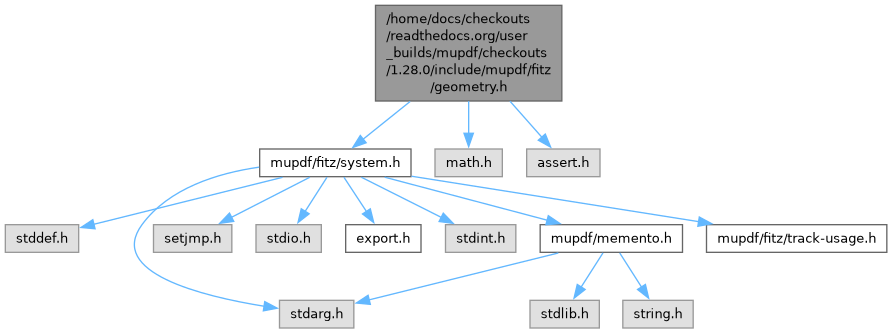
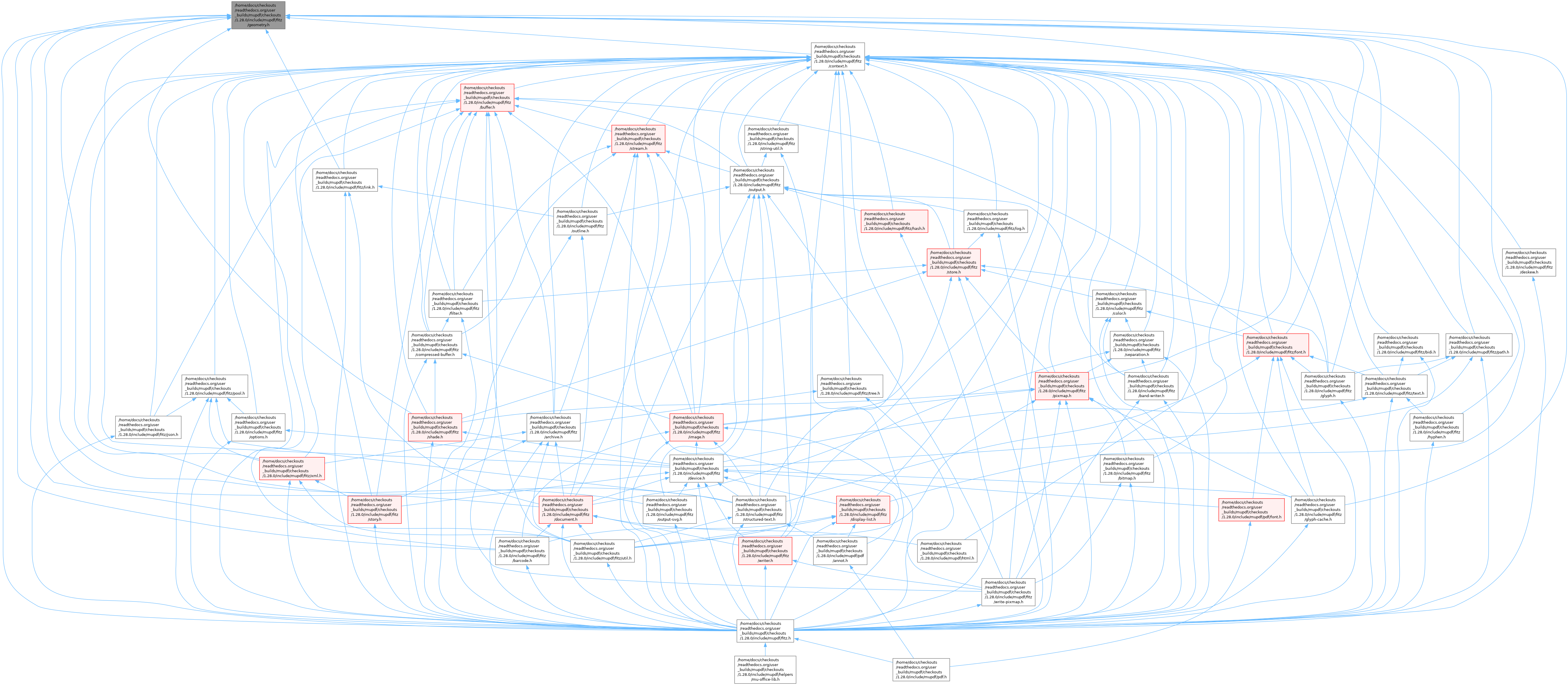
Go to the source code of this file.
Classes | |
| struct | fz_point |
| struct | fz_rect |
| struct | fz_irect |
| struct | fz_matrix |
| struct | fz_quad |
Macros | |
| #define | M_PI 3.14159265358979323846 |
| #define | FZ_EXPAND(A) |
| #define | FZ_COMBINE(A, B) |
| #define | FZ_COMBINE2(A, B, C, D) |
| #define | FZ_BLEND(SRC, DST, AMOUNT) |
| #define | DIV_BY_ZERO(a, b, min, max) |
| #define | FZ_MIN_INF_RECT ((int)0x80000000) |
| #define | FZ_MAX_INF_RECT ((int)0x7fffff80) |
| #define | fz_bytes_from_bits(A) |
Variables | |
| FZ_DATA const fz_rect | fz_unit_rect |
| FZ_DATA const fz_rect | fz_empty_rect |
| FZ_DATA const fz_irect | fz_empty_irect |
| FZ_DATA const fz_rect | fz_infinite_rect |
| FZ_DATA const fz_irect | fz_infinite_irect |
| FZ_DATA const fz_rect | fz_invalid_rect |
| FZ_DATA const fz_irect | fz_invalid_irect |
| FZ_DATA const fz_matrix | fz_identity |
| FZ_DATA const fz_quad | fz_invalid_quad |
| FZ_DATA const fz_quad | fz_infinite_quad |
Macro Definition Documentation
◆ DIV_BY_ZERO
| #define DIV_BY_ZERO | ( | a, | |
| b, | |||
| min, | |||
| max ) |
◆ FZ_BLEND
| #define FZ_BLEND | ( | SRC, | |
| DST, | |||
| AMOUNT ) |
Blend SRC and DST (in the same range) together according to AMOUNT (in the 0...256 range).
◆ fz_bytes_from_bits
| #define fz_bytes_from_bits | ( | A | ) |
◆ FZ_COMBINE
| #define FZ_COMBINE | ( | A, | |
| B ) |
Combine values A (in any range) and B (in the 0..256 range), to give a single value in the same range as A was.
◆ FZ_COMBINE2
| #define FZ_COMBINE2 | ( | A, | |
| B, | |||
| C, | |||
| D ) |
Combine values A and C (in the same (any) range) and B and D (in the 0..256 range), to give a single value in the same range as A and C were.
◆ FZ_EXPAND
| #define FZ_EXPAND | ( | A | ) |
Expand a value A from the 0...255 range to the 0..256 range
◆ FZ_MAX_INF_RECT
| #define FZ_MAX_INF_RECT ((int)0x7fffff80) |
◆ FZ_MIN_INF_RECT
| #define FZ_MIN_INF_RECT ((int)0x80000000) |
fz_rect is a rectangle represented by two diagonally opposite corners at arbitrary coordinates.
Rectangles are always axis-aligned with the X- and Y- axes. We wish to distinguish rectangles in 3 categories; infinite, finite, and invalid. Zero area rectangles are a sub-category of finite ones.
For all valid rectangles, x0 <= x1 and y0 <= y1 in all cases. Infinite rectangles have x0 = y0 = FZ_MIN_INF_RECT, x1 = y1 = FZ_MAX_INF_RECT. For any non infinite valid rectangle, the area is defined as (x1 - x0) * (y1 - y0).
To check for empty or infinite rectangles use fz_is_empty_rect and fz_is_infinite_rect. To check for valid rectangles use fz_is_valid_rect.
We choose this representation, so that we can easily distinguish the difference between intersecting 2 valid rectangles and getting an invalid one, as opposed to getting a zero area one (which nonetheless has valid bounds within the plane).
x0, y0: The top left corner.
x1, y1: The bottom right corner.
We choose FZ_{MIN,MAX}_INF_RECT to be the largest 32bit signed integer values that survive roundtripping to floats.
◆ M_PI
| #define M_PI 3.14159265358979323846 |
Function Documentation
◆ fz_atof()
| float fz_atof | ( | const char * | s | ) |
Range checking atof
◆ fz_atoi()
| int fz_atoi | ( | const char * | s | ) |
atoi that copes with NULL
◆ fz_atoi64()
| int64_t fz_atoi64 | ( | const char * | s | ) |
64bit atoi that copes with NULL
◆ fz_atoz()
| size_t fz_atoz | ( | const char * | s | ) |
size_t atoi that copes with NULL.
NOTE: limited to 63bits. Negative numbers are returned as 0.
◆ fz_ckd_add_i32()
| int fz_ckd_add_i32 | ( | int32_t * | out, |
| int32_t | a, | ||
| int32_t | b ) |
◆ fz_ckd_add_i64()
| int fz_ckd_add_i64 | ( | int64_t * | out, |
| int64_t | a, | ||
| int64_t | b ) |
◆ fz_ckd_add_int()
| int fz_ckd_add_int | ( | int * | out, |
| int | a, | ||
| int | b ) |
◆ fz_ckd_add_size()
| int fz_ckd_add_size | ( | size_t * | out, |
| size_t | a, | ||
| size_t | b ) |
◆ fz_ckd_add_u32()
| int fz_ckd_add_u32 | ( | uint32_t * | out, |
| uint32_t | a, | ||
| uint32_t | b ) |
◆ fz_ckd_add_u64()
| int fz_ckd_add_u64 | ( | uint64_t * | out, |
| uint64_t | a, | ||
| uint64_t | b ) |
◆ fz_ckd_add_uint()
| int fz_ckd_add_uint | ( | unsigned int * | out, |
| unsigned int | a, | ||
| unsigned int | b ) |
◆ fz_ckd_int_from_i64()
| int fz_ckd_int_from_i64 | ( | int * | out, |
| int64_t | in ) |
◆ fz_ckd_mul_i32()
| int fz_ckd_mul_i32 | ( | int32_t * | out, |
| int32_t | a, | ||
| int32_t | b ) |
◆ fz_ckd_mul_i64()
| int fz_ckd_mul_i64 | ( | int64_t * | out, |
| int64_t | a, | ||
| int64_t | b ) |
◆ fz_ckd_mul_int()
| int fz_ckd_mul_int | ( | int * | out, |
| int | a, | ||
| int | b ) |
◆ fz_ckd_mul_size()
| int fz_ckd_mul_size | ( | size_t * | out, |
| size_t | a, | ||
| size_t | b ) |
◆ fz_ckd_mul_u32()
| int fz_ckd_mul_u32 | ( | uint32_t * | out, |
| uint32_t | a, | ||
| uint32_t | b ) |
◆ fz_ckd_mul_u64()
| int fz_ckd_mul_u64 | ( | uint64_t * | out, |
| uint64_t | a, | ||
| uint64_t | b ) |
◆ fz_ckd_mul_uint()
| int fz_ckd_mul_uint | ( | unsigned int * | out, |
| unsigned int | a, | ||
| unsigned int | b ) |
◆ fz_ckd_size_from_i64()
| int fz_ckd_size_from_i64 | ( | size_t * | out, |
| int64_t | in ) |
◆ fz_ckd_sub_i32()
| int fz_ckd_sub_i32 | ( | int32_t * | out, |
| int32_t | a, | ||
| int32_t | b ) |
◆ fz_ckd_sub_i64()
| int fz_ckd_sub_i64 | ( | int64_t * | out, |
| int64_t | a, | ||
| int64_t | b ) |
◆ fz_ckd_sub_int()
| int fz_ckd_sub_int | ( | int * | out, |
| int | a, | ||
| int | b ) |
◆ fz_ckd_sub_size()
| int fz_ckd_sub_size | ( | size_t * | out, |
| size_t | a, | ||
| size_t | b ) |
◆ fz_ckd_sub_u32()
| int fz_ckd_sub_u32 | ( | uint32_t * | out, |
| uint32_t | a, | ||
| uint32_t | b ) |
◆ fz_ckd_sub_u64()
| int fz_ckd_sub_u64 | ( | uint64_t * | out, |
| uint64_t | a, | ||
| uint64_t | b ) |
◆ fz_ckd_sub_uint()
| int fz_ckd_sub_uint | ( | unsigned int * | out, |
| unsigned int | a, | ||
| unsigned int | b ) |
◆ fz_concat()
Multiply two matrices.
The order of the two matrices are important since matrix multiplication is not commutative.
Returns result.
◆ fz_contains_rect()
Test rectangle inclusion.
Return true if a entirely contains b.
◆ fz_expand_irect()
◆ fz_expand_rect()
Expand a bbox by a given amount in all directions.
◆ fz_gridfit_matrix()
Grid fit a matrix.
as_tiled = 0 => adjust the matrix so that the image of the unit square completely covers any pixel that was touched by the image of the unit square under the original matrix.
as_tiled = 1 => adjust the matrix so that the corners of the image of the unit square align with the closest integer corner of the image of the unit square under the original matrix.
◆ fz_include_point_in_rect()
Expand a bbox to include a given point. To create a rectangle that encompasses a sequence of points, the rectangle must first be set to be the empty rectangle at one of the points before including the others.
◆ fz_intersect_irect()
Compute intersection of two bounding boxes.
Similar to fz_intersect_rect but operates on two bounding boxes instead of two rectangles.
◆ fz_intersect_rect()
Compute intersection of two rectangles.
Given two rectangles, update the first to be the smallest axis-aligned rectangle that covers the area covered by both given rectangles. If either rectangle is empty then the intersection is also empty. If either rectangle is infinite then the intersection is simply the non-infinite rectangle. Should both rectangles be infinite, then the intersection is also infinite.
◆ fz_invert_matrix()
Create an inverse matrix.
matrix: Matrix to invert. A degenerate matrix, where the determinant is equal to zero, can not be inverted and the original matrix is returned instead.
Returns inverse.
◆ fz_irect_from_rect()
Convert a rect into the minimal bounding box that covers the rectangle.
Coordinates in a bounding box are integers, so rounding of the rects coordinates takes place. The top left corner is rounded upwards and left while the bottom right corner is rounded downwards and to the right.
◆ fz_is_empty_quad()
| int fz_is_empty_quad | ( | fz_quad | q | ) |
Is a quad empty?
◆ fz_is_infinite_quad()
| int fz_is_infinite_quad | ( | fz_quad | q | ) |
Is a quad infinite?
◆ fz_is_irect_inside_irect()
Inclusion test for irects.
rects are assumed to be both open or both closed.
No invalid rect can include any other rect. No invalid rect can be included by any rect. Empty (point) rects can include themselves. Empty (line) rects can include many (subline) rects.
◆ fz_is_point_inside_irect()
| int fz_is_point_inside_irect | ( | int | x, |
| int | y, | ||
| fz_irect | r ) |
Inclusion test for irects. (Rect is assumed to be open, i.e. top right corner is not included).
◆ fz_is_point_inside_quad()
◆ fz_is_point_inside_rect()
Inclusion test for rects. (Rect is assumed to be open, i.e. top right corner is not included).
◆ fz_is_quad_inside_quad()
Inclusion test for quad in quad.
This may break down if quads are not 'well formed'.
◆ fz_is_quad_intersecting_quad()
Intersection test for quads.
This may break down if quads are not 'well formed'.
◆ fz_is_rect_inside_rect()
Inclusion test for rects.
rects are assumed to be both open or both closed.
No invalid rect can include any other rect. No invalid rect can be included by any rect. Empty (point) rects can include themselves. Empty (line) rects can include many (subline) rects.
◆ fz_is_rectilinear()
| int fz_is_rectilinear | ( | fz_matrix | m | ) |
Check if a transformation is rectilinear.
Rectilinear means that no shearing is present and that any rotations present are a multiple of 90 degrees. Usually this is used to make sure that axis-aligned rectangles before the transformation are still axis-aligned rectangles afterwards.
◆ fz_is_valid_quad()
| int fz_is_valid_quad | ( | fz_quad | q | ) |
Is a quad valid?
◆ fz_matrix_expansion()
| float fz_matrix_expansion | ( | fz_matrix | m | ) |
Calculate average scaling factor of matrix.
◆ fz_matrix_max_expansion()
| float fz_matrix_max_expansion | ( | fz_matrix | m | ) |
Find the largest expansion performed by this matrix. (i.e. max(abs(m.a),abs(m.b),abs(m.c),abs(m.d))
◆ fz_normalize_vector()
◆ fz_overlaps_rect()
Test rectangle overlap.
Returns true if the area of the overlap is non zero.
◆ fz_post_scale()
Scale a matrix by postmultiplication.
m: Pointer to the matrix to scale
sx, sy: Scaling factors along the X- and Y-axes. A scaling factor of 1.0 will not cause any scaling along the relevant axis.
Returns m (updated).
◆ fz_pre_rotate()
Rotate a transformation by premultiplying.
The premultiplied matrix is of the form [ cos(deg) sin(deg) -sin(deg) cos(deg) 0 0 ].
m: Pointer to matrix to premultiply.
degrees: Degrees of counter clockwise rotation. Values less than zero and greater than 360 are handled as expected.
Returns m (updated).
◆ fz_pre_scale()
Scale a matrix by premultiplication.
m: Pointer to the matrix to scale
sx, sy: Scaling factors along the X- and Y-axes. A scaling factor of 1.0 will not cause any scaling along the relevant axis.
Returns m (updated).
◆ fz_pre_shear()
Premultiply a matrix with a shearing matrix.
The shearing matrix is of the form [ 1 sy sx 1 0 0 ].
m: pointer to matrix to premultiply
sx, sy: Shearing factors. A shearing factor of 0.0 will not cause any shearing along the relevant axis.
Returns m (updated).
◆ fz_pre_translate()
Translate a matrix by premultiplication.
m: The matrix to translate
tx, ty: Translation distances along the X- and Y-axes. A translation of 0 will not cause any translation along the relevant axis.
Returns m.
◆ fz_quad_from_rect()
◆ fz_rect_area()
| float fz_rect_area | ( | fz_rect | r | ) |
Calculate the area of a rectangle.
Always non-negative. All invalid or empty rects return 0.
◆ fz_rect_from_irect()
Convert a bbox into a rect.
For our purposes, a rect can represent all the values we meet in a bbox, so nothing can go wrong.
rect: A place to store the generated rectangle.
bbox: The bbox to convert.
Returns rect (updated).
◆ fz_rect_from_quad()
◆ fz_rotate()
| fz_matrix fz_rotate | ( | float | degrees | ) |
Create a rotation matrix.
The returned matrix is of the form [ cos(deg) sin(deg) -sin(deg) cos(deg) 0 0 ].
m: Pointer to place to store matrix
degrees: Degrees of counter clockwise rotation. Values less than zero and greater than 360 are handled as expected.
Returns m.
◆ fz_round_rect()
Round rectangle coordinates.
Coordinates in a bounding box are integers, so rounding of the rects coordinates takes place. The top left corner is rounded upwards and left while the bottom right corner is rounded downwards and to the right.
This differs from fz_irect_from_rect, in that fz_irect_from_rect slavishly follows the numbers (i.e any slight over/under calculations can cause whole extra pixels to be added). fz_round_rect allows for a small amount of rounding error when calculating the bbox.
◆ fz_scale()
| fz_matrix fz_scale | ( | float | sx, |
| float | sy ) |
Create a scaling matrix.
The returned matrix is of the form [ sx 0 0 sy 0 0 ].
m: Pointer to the matrix to populate
sx, sy: Scaling factors along the X- and Y-axes. A scaling factor of 1.0 will not cause any scaling along the relevant axis.
Returns m.
◆ fz_shear()
| fz_matrix fz_shear | ( | float | sx, |
| float | sy ) |
Create a shearing matrix.
The returned matrix is of the form [ 1 sy sx 1 0 0 ].
m: pointer to place to store returned matrix
sx, sy: Shearing factors. A shearing factor of 0.0 will not cause any shearing along the relevant axis.
Returns m.
◆ fz_transform_page()
Create transform matrix to draw page at a given resolution and rotation. Adjusts the scaling factors so that the page covers whole number of pixels and adjust the page origin to be at 0,0.
◆ fz_transform_point()
Apply a transformation to a point.
transform: Transformation matrix to apply. See fz_concat, fz_scale, fz_rotate and fz_translate for how to create a matrix.
point: Pointer to point to update.
Returns transform (unchanged).
◆ fz_transform_point_xy()
◆ fz_transform_quad()
◆ fz_transform_rect()
Apply a transform to a rectangle.
After the four corner points of the axis-aligned rectangle have been transformed it may not longer be axis-aligned. So a new axis-aligned rectangle is created covering at least the area of the transformed rectangle.
transform: Transformation matrix to apply. See fz_concat, fz_scale and fz_rotate for how to create a matrix.
rect: Rectangle to be transformed. The two special cases fz_empty_rect and fz_infinite_rect, may be used but are returned unchanged as expected.
◆ fz_transform_vector()
Apply a transformation to a vector.
transform: Transformation matrix to apply. See fz_concat, fz_scale and fz_rotate for how to create a matrix. Any translation will be ignored.
vector: Pointer to vector to update.
◆ fz_translate()
| fz_matrix fz_translate | ( | float | tx, |
| float | ty ) |
Create a translation matrix.
The returned matrix is of the form [ 1 0 0 1 tx ty ].
m: A place to store the created matrix.
tx, ty: Translation distances along the X- and Y-axes. A translation of 0 will not cause any translation along the relevant axis.
Returns m.
◆ fz_translate_irect()
◆ fz_translate_rect()
Translate bounding box.
Translate a bbox by a given x and y offset. Allows for overflow.
◆ fz_try_invert_matrix()
Attempt to create an inverse matrix.
inv: Place to store inverse matrix.
src: Matrix to invert. A degenerate matrix, where the determinant is equal to zero, can not be inverted.
Returns 1 if matrix is degenerate (singular), or 0 otherwise.
◆ fz_union_rect()
Compute union of two rectangles.
Given two rectangles, update the first to be the smallest axis-aligned rectangle that encompasses both given rectangles. If either rectangle is infinite then the union is also infinite. If either rectangle is empty then the union is simply the non-empty rectangle. Should both rectangles be empty, then the union is also empty.