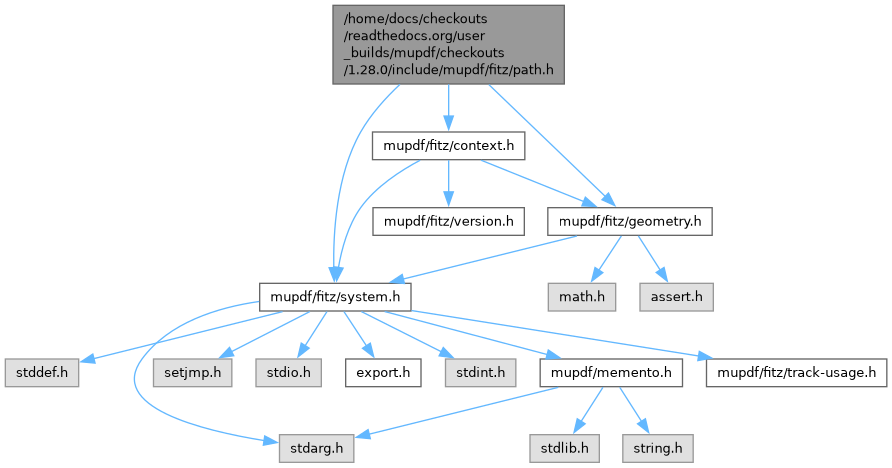
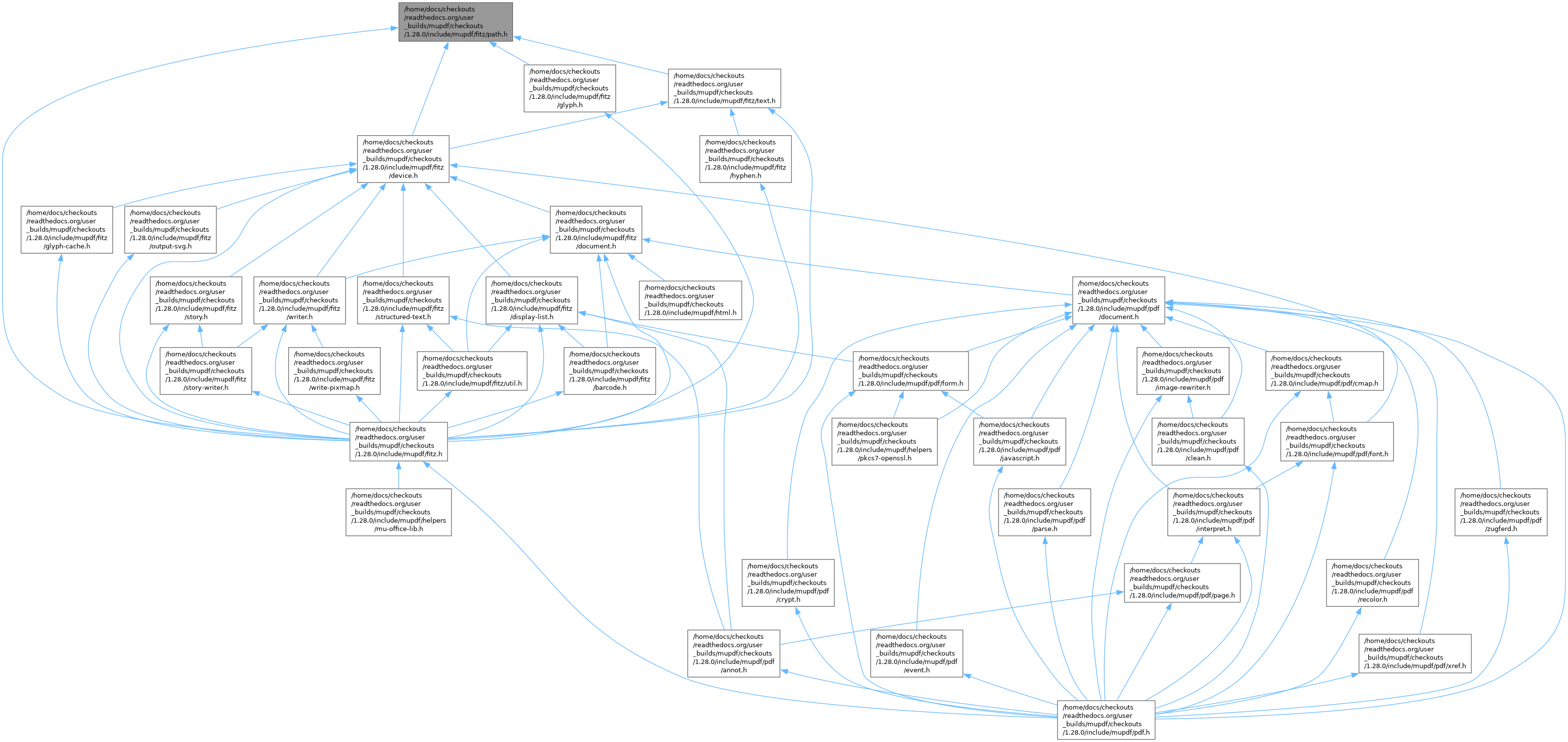
Go to the source code of this file.
Classes | |
| struct | fz_stroke_state |
| struct | fz_path_walker |
Typedefs | |
| typedef struct fz_path | fz_path |
Enumerations | |
| enum | fz_linecap { FZ_LINECAP_BUTT = 0 , FZ_LINECAP_ROUND = 1 , FZ_LINECAP_SQUARE = 2 , FZ_LINECAP_TRIANGLE = 3 } |
| enum | fz_linejoin { FZ_LINEJOIN_MITER = 0 , FZ_LINEJOIN_ROUND = 1 , FZ_LINEJOIN_BEVEL = 2 , FZ_LINEJOIN_MITER_XPS = 3 } |
Variables | |
| FZ_DATA const fz_stroke_state | fz_default_stroke_state |
Typedef Documentation
◆ fz_path
Vector path buffer. It can be stroked and dashed, or be filled. It has a fill rule (nonzero or even_odd).
When rendering, they are flattened, stroked and dashed straight into the Global Edge List.
Enumeration Type Documentation
◆ fz_linecap
| enum fz_linecap |
◆ fz_linejoin
| enum fz_linejoin |
Function Documentation
◆ fz_adjust_rect_for_stroke()
| fz_rect fz_adjust_rect_for_stroke | ( | fz_context * | ctx, |
| fz_rect | rect, | ||
| const fz_stroke_state * | stroke, | ||
| fz_matrix | ctm ) |
Given a rectangle (assumed to be the bounding box for a path), expand it to allow for the expansion of the bbox that would be seen by stroking the path with the given stroke state and transform.
◆ fz_bound_path()
| fz_rect fz_bound_path | ( | fz_context * | ctx, |
| const fz_path * | path, | ||
| const fz_stroke_state * | stroke, | ||
| fz_matrix | ctm ) |
Return a bounding rectangle for a path.
path: The path to bound.
stroke: If NULL, the bounding rectangle given is for the filled path. If non-NULL the bounding rectangle given is for the path stroked with the given attributes.
ctm: The matrix to apply to the path during stroking.
r: Pointer to a fz_rect which will be used to hold the result.
Returns r, updated to contain the bounding rectangle.
◆ fz_clone_path()
| fz_path * fz_clone_path | ( | fz_context * | ctx, |
| fz_path * | path ) |
Clone the data for a path.
This is used in preference to fz_keep_path when a whole new copy of a path is required, rather than just a shared pointer. This probably indicates that the path is about to be modified.
path: path to clone.
Throws exceptions on failure to allocate.
◆ fz_clone_stroke_state()
| fz_stroke_state * fz_clone_stroke_state | ( | fz_context * | ctx, |
| const fz_stroke_state * | stroke ) |
Create an identical stroke_state structure and return a reference to it.
stroke: The stroke state reference to clone.
Exceptions may be thrown in the event of a failure to allocate.
◆ fz_closepath()
| void fz_closepath | ( | fz_context * | ctx, |
| fz_path * | path ) |
Close the current subpath.
path: The path to modify.
Throws exceptions on failure to allocate, attempting to modify a packed path, and illegal path closes (i.e. closing a non open path).
◆ fz_currentpoint()
| fz_point fz_currentpoint | ( | fz_context * | ctx, |
| fz_path * | path ) |
Return the current point that a path has reached or (0,0) if empty.
path: path to return the current point of.
◆ fz_curveto()
| void fz_curveto | ( | fz_context * | ctx, |
| fz_path * | path, | ||
| float | x0, | ||
| float | y0, | ||
| float | x1, | ||
| float | y1, | ||
| float | x2, | ||
| float | y2 ) |
Append a 'curveto' command to an open path. (For a cubic bezier).
path: The path to modify.
x0, y0: The coordinates of the first control point for the curve.
x1, y1: The coordinates of the second control point for the curve.
x2, y2: The end coordinates for the curve.
Throws exceptions on failure to allocate, or attempting to modify a packed path.
◆ fz_curvetov()
| void fz_curvetov | ( | fz_context * | ctx, |
| fz_path * | path, | ||
| float | x1, | ||
| float | y1, | ||
| float | x2, | ||
| float | y2 ) |
Append a 'curvetov' command to an open path. (For a cubic bezier with the first control coordinate equal to the start point).
path: The path to modify.
x1, y1: The coordinates of the second control point for the curve.
x2, y2: The end coordinates for the curve.
Throws exceptions on failure to allocate, or attempting to modify a packed path.
◆ fz_curvetoy()
| void fz_curvetoy | ( | fz_context * | ctx, |
| fz_path * | path, | ||
| float | x0, | ||
| float | y0, | ||
| float | x2, | ||
| float | y2 ) |
Append a 'curvetoy' command to an open path. (For a cubic bezier with the second control coordinate equal to the end point).
path: The path to modify.
x0, y0: The coordinates of the first control point for the curve.
x2, y2: The end coordinates for the curve (and the second control coordinate).
Throws exceptions on failure to allocate, or attempting to modify a packed path.
◆ fz_drop_path()
| void fz_drop_path | ( | fz_context * | ctx, |
| const fz_path * | path ) |
Decrement the reference count. When the reference count hits zero, free the path.
All paths can be dropped, regardless of their packing type. Packed paths do not own the blocks into which they are packed so dropping them does not free those blocks.
Never throws exceptions.
◆ fz_drop_stroke_state()
| void fz_drop_stroke_state | ( | fz_context * | ctx, |
| const fz_stroke_state * | stroke ) |
Drop a reference to a stroke state structure, destroying the structure if it is the last reference.
◆ fz_keep_path()
| fz_path * fz_keep_path | ( | fz_context * | ctx, |
| const fz_path * | path ) |
Increment the reference count. Returns the same pointer.
All paths can be kept, regardless of their packing type.
Never throws exceptions.
◆ fz_keep_stroke_state()
| fz_stroke_state * fz_keep_stroke_state | ( | fz_context * | ctx, |
| const fz_stroke_state * | stroke ) |
Take an additional reference to a stroke state structure.
No modifications should be carried out on a stroke state to which more than one reference is held, as this can cause race conditions.
◆ fz_linecap_from_string()
| fz_linecap fz_linecap_from_string | ( | const char * | s | ) |
◆ fz_linejoin_from_string()
| fz_linejoin fz_linejoin_from_string | ( | const char * | s | ) |
◆ fz_lineto()
| void fz_lineto | ( | fz_context * | ctx, |
| fz_path * | path, | ||
| float | x, | ||
| float | y ) |
Append a 'lineto' command to an open path.
path: The path to modify.
x, y: The coordinate to line to.
Throws exceptions on failure to allocate, or attempting to modify a packed path.
◆ fz_moveto()
| void fz_moveto | ( | fz_context * | ctx, |
| fz_path * | path, | ||
| float | x, | ||
| float | y ) |
Append a 'moveto' command to a path. This 'opens' a path.
path: The path to modify.
x, y: The coordinate to move to.
Throws exceptions on failure to allocate, or attempting to modify a packed path.
◆ fz_new_path()
| fz_path * fz_new_path | ( | fz_context * | ctx | ) |
Create a new (empty) path structure.
◆ fz_new_stroke_state()
| fz_stroke_state * fz_new_stroke_state | ( | fz_context * | ctx | ) |
Create a new (empty) stroke state structure (with no dash data) and return a reference to it.
Throws exception on failure to allocate.
◆ fz_new_stroke_state_with_dash_len()
| fz_stroke_state * fz_new_stroke_state_with_dash_len | ( | fz_context * | ctx, |
| int | len ) |
Create a new (empty) stroke state structure, with room for dash data of the given length, and return a reference to it.
len: The number of dash elements to allow room for.
Throws exception on failure to allocate.
◆ fz_pack_path()
| size_t fz_pack_path | ( | fz_context * | ctx, |
| uint8_t * | pack, | ||
| const fz_path * | path ) |
Pack a path into the given block. To minimise the size of paths, this function allows them to be packed into a buffer with other information. Paths can be used interchangeably regardless of how they are packed.
pack: Pointer to a block of data to pack the path into. Should be aligned by the caller to the same alignment as required for a fz_path pointer.
path: The path to pack.
Returns the number of bytes within the block used. Callers can access the packed path data by casting the value of pack on entry to be a fz_path *.
Throws exceptions on failure to allocate.
Implementation details: Paths can be 'unpacked', 'flat', or 'open'. Standard paths, as created are 'unpacked'. Paths will be packed as 'flat', unless they are too large (where large indicates that they exceed some private implementation defined limits, currently including having more than 256 coordinates or commands).
Large paths are 'open' packed as a header into the given block, plus pointers to other data blocks.
Users should not have to care about whether paths are 'open' or 'flat' packed. Simply pack a path (if required), and then forget about the details.
◆ fz_packed_path_size()
| int fz_packed_path_size | ( | const fz_path * | path | ) |
Return the number of bytes required to pack a path.
◆ fz_path_is_closed()
| int fz_path_is_closed | ( | fz_context * | ctx, |
| const fz_path * | path ) |
Check whether a given path has all its segments closed.
This includes both explicit closepaths, and where segments are implicitly closed by segments that end where they started.
◆ fz_path_is_empty()
| int fz_path_is_empty | ( | fz_context * | ctx, |
| const fz_path * | path ) |
Find out if a path is completely empty.
◆ fz_path_is_rect()
| int fz_path_is_rect | ( | fz_context * | ctx, |
| const fz_path * | path, | ||
| fz_matrix | ctm ) |
Check whether a given path, under the given transform is an axis-aligned rectangle.
We accept zero width or height rectangles, so "move 100, 100; line 200, 100" would count as a rectangle too.
◆ fz_path_is_rect_with_bounds()
| int fz_path_is_rect_with_bounds | ( | fz_context * | ctx, |
| const fz_path * | path, | ||
| fz_matrix | ctm, | ||
| fz_rect * | bounds ) |
Check whether a given path, under the given transform is an axis-aligned rectangle.
We accept zero width or height rectangles, so "move 100, 100; line 200, 100" would count as a rectangle too.
bounds = NULL, or place to return the rectangle bounds if the path is a rectangle.
◆ fz_quadto()
| void fz_quadto | ( | fz_context * | ctx, |
| fz_path * | path, | ||
| float | x0, | ||
| float | y0, | ||
| float | x1, | ||
| float | y1 ) |
Append a 'quadto' command to an open path. (For a quadratic bezier).
path: The path to modify.
x0, y0: The control coordinates for the quadratic curve.
x1, y1: The end coordinates for the quadratic curve.
Throws exceptions on failure to allocate, or attempting to modify a packed path.
◆ fz_rectto()
| void fz_rectto | ( | fz_context * | ctx, |
| fz_path * | path, | ||
| float | x0, | ||
| float | y0, | ||
| float | x1, | ||
| float | y1 ) |
Append a 'rectto' command to an open path.
The rectangle is equivalent to: moveto x0 y0 lineto x1 y0 lineto x1 y1 lineto x0 y1 closepath
path: The path to modify.
x0, y0: First corner of the rectangle.
x1, y1: Second corner of the rectangle.
Throws exceptions on failure to allocate, or attempting to modify a packed path.
◆ fz_string_from_linecap()
| const char * fz_string_from_linecap | ( | fz_linecap | cap | ) |
◆ fz_string_from_linejoin()
| const char * fz_string_from_linejoin | ( | fz_linejoin | join | ) |
◆ fz_stroke_state_eq()
| int fz_stroke_state_eq | ( | fz_context * | ctx, |
| const fz_stroke_state * | a, | ||
| const fz_stroke_state * | b ) |
◆ fz_transform_path()
| void fz_transform_path | ( | fz_context * | ctx, |
| fz_path * | path, | ||
| fz_matrix | transform ) |
Transform a path by a given matrix.
path: The path to modify (must not be a packed path).
transform: The transform to apply.
Throws exceptions if the path is packed, or on failure to allocate.
◆ fz_trim_path()
| void fz_trim_path | ( | fz_context * | ctx, |
| fz_path * | path ) |
Minimise the internal storage used by a path.
As paths are constructed, the internal buffers grow. To avoid repeated reallocations they grow with some spare space. Once a path has been fully constructed, this call allows the excess space to be trimmed.
◆ fz_unshare_stroke_state()
| fz_stroke_state * fz_unshare_stroke_state | ( | fz_context * | ctx, |
| fz_stroke_state * | shared ) |
Given a reference to a (possibly) shared stroke_state structure, return a reference to an equivalent stroke_state structure that is guaranteed to be unshared (i.e. one that can safely be modified).
shared: The reference to a (possibly) shared structure to unshare. Ownership of this reference is passed in to this function, even in the case of exceptions being thrown.
Exceptions may be thrown in the event of failure to allocate if required.
◆ fz_unshare_stroke_state_with_dash_len()
| fz_stroke_state * fz_unshare_stroke_state_with_dash_len | ( | fz_context * | ctx, |
| fz_stroke_state * | shared, | ||
| int | len ) |
Given a reference to a (possibly) shared stroke_state structure, return a reference to a stroke_state structure (with room for a given amount of dash data) that is guaranteed to be unshared (i.e. one that can safely be modified).
shared: The reference to a (possibly) shared structure to unshare. Ownership of this reference is passed in to this function, even in the case of exceptions being thrown.
Exceptions may be thrown in the event of failure to allocate if required.
◆ fz_walk_path()
| void fz_walk_path | ( | fz_context * | ctx, |
| const fz_path * | path, | ||
| const fz_path_walker * | walker, | ||
| void * | arg ) |
Walk the segments of a path, calling the appropriate callback function from a given set for each segment of the path.
path: The path to walk.
walker: The set of callback functions to use. The first 4 callback pointers in the set must be non-NULL. The subsequent ones can either be supplied, or can be left as NULL, in which case the top 4 functions will be called as appropriate to simulate them.
arg: An opaque argument passed in to each callback.
Exceptions will only be thrown if the underlying callback functions throw them.
Variable Documentation
◆ fz_default_stroke_state
|
extern |
A sane 'default' stroke state.