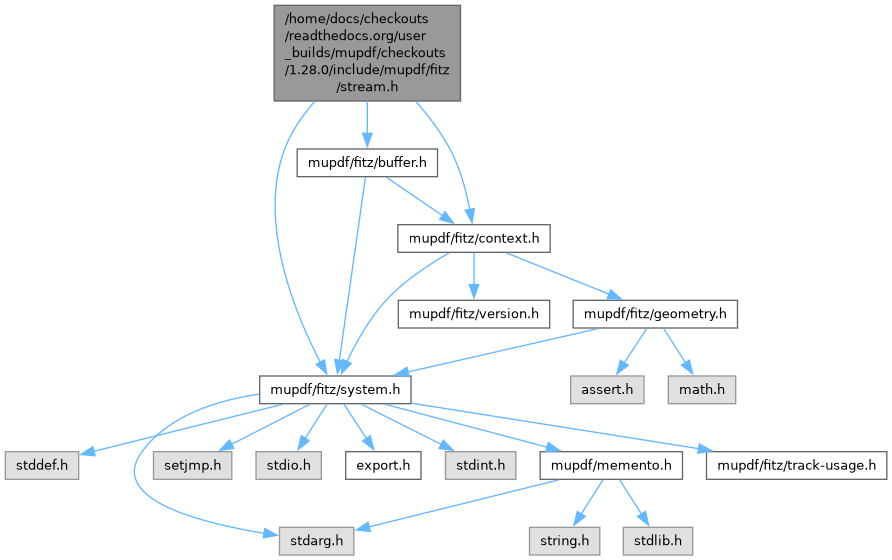
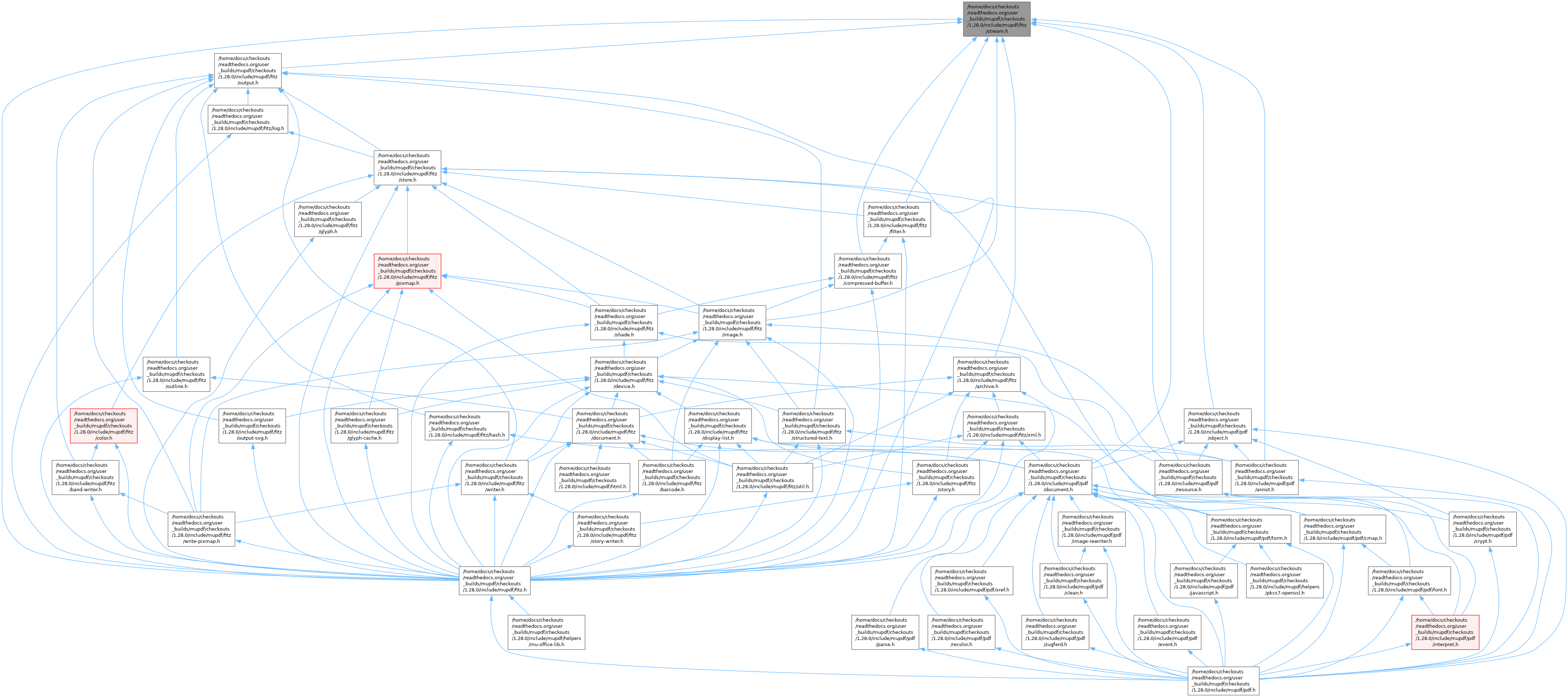
Go to the source code of this file.
Classes | |
| struct | fz_stream |
Typedefs | |
| typedef struct fz_stream | fz_stream |
| typedef int | fz_stream_next_fn(fz_context *ctx, fz_stream *stm, size_t max) |
| typedef void | fz_stream_drop_fn(fz_context *ctx, void *state) |
| typedef void | fz_stream_seek_fn(fz_context *ctx, fz_stream *stm, int64_t offset, int whence) |
Typedef Documentation
◆ fz_stream
| typedef struct fz_stream fz_stream |
fz_stream is a buffered reader capable of seeking in both directions.
Streams are reference counted, so references must be dropped by a call to fz_drop_stream.
Only the data between rp and wp is valid.
◆ fz_stream_drop_fn
| typedef void fz_stream_drop_fn(fz_context *ctx, void *state) |
A function type for use when implementing fz_streams. The supplied function of this type is called when the stream is dropped, to release the stream specific state information.
state: The stream state to release.
◆ fz_stream_next_fn
| typedef int fz_stream_next_fn(fz_context *ctx, fz_stream *stm, size_t max) |
A function type for use when implementing fz_streams. The supplied function of this type is called whenever data is required, and the current buffer is empty.
stm: The stream to operate on.
max: a hint as to the maximum number of bytes that the caller needs to be ready immediately. Can safely be ignored.
Returns -1 if there is no more data in the stream. Otherwise, the function should find its internal state using stm->state, refill its buffer, update stm->rp and stm->wp to point to the start and end of the new data respectively, and then "return *stm->rp++".
◆ fz_stream_seek_fn
| typedef void fz_stream_seek_fn(fz_context *ctx, fz_stream *stm, int64_t offset, int whence) |
A function type for use when implementing fz_streams. The supplied function of this type is called when fz_seek is requested, and the arguments are as defined for fz_seek.
The stream can find it's private state in stm->state.
Function Documentation
◆ fz_drop_stream()
| void fz_drop_stream | ( | fz_context * | ctx, |
| fz_stream * | stm ) |
Decrements the reference count for a stream.
When the reference count for the stream hits zero, frees the storage used for the fz_stream itself, and (usually) releases the underlying resources that the stream is based upon (depends on the method used to open the stream initially).
◆ fz_file_exists()
| int fz_file_exists | ( | fz_context * | ctx, |
| const char * | path ) |
Return true if the named file exists and is readable.
◆ fz_keep_stream()
| fz_stream * fz_keep_stream | ( | fz_context * | ctx, |
| fz_stream * | stm ) |
Increments the reference count for a stream. Returns the same pointer.
Never throws exceptions.
◆ fz_new_stream()
| fz_stream * fz_new_stream | ( | fz_context * | ctx, |
| void * | state, | ||
| fz_stream_next_fn * | next, | ||
| fz_stream_drop_fn * | drop ) |
Create a new stream object with the given internal state and function pointers.
state: Internal state (opaque to everything but implementation).
next: Should provide the next set of bytes (up to max) of stream data. Return the number of bytes read, or EOF when there is no more data.
drop: Should clean up and free the internal state. May not throw exceptions.
◆ fz_open_buffer()
| fz_stream * fz_open_buffer | ( | fz_context * | ctx, |
| fz_buffer * | buf ) |
Open a buffer as a stream.
buf: The buffer to open. Ownership of the buffer is NOT passed in (this function takes its own reference).
Returns pointer to newly created stream. May throw exceptions on failure to allocate.
◆ fz_open_file()
| fz_stream * fz_open_file | ( | fz_context * | ctx, |
| const char * | filename ) |
Open the named file and wrap it in a stream.
filename: Path to a file. On non-Windows machines the filename should be exactly as it would be passed to fopen(2). On Windows machines, the path should be UTF-8 encoded so that non-ASCII characters can be represented. Other platforms do the encoding as standard anyway (and in most cases, particularly for MacOS and Linux, the encoding they use is UTF-8 anyway).
◆ fz_open_file_autodelete()
| fz_stream * fz_open_file_autodelete | ( | fz_context * | ctx, |
| const char * | filename ) |
Do the same as fz_open_file, but delete the file upon close.
◆ fz_open_file_ptr_no_close()
| fz_stream * fz_open_file_ptr_no_close | ( | fz_context * | ctx, |
| FILE * | file ) |
Create a stream from a FILE * that will not be closed when the stream is dropped.
◆ fz_open_leecher()
| fz_stream * fz_open_leecher | ( | fz_context * | ctx, |
| fz_stream * | chain, | ||
| fz_buffer * | buf ) |
Attach a filter to a stream that will store any characters read from the stream into the supplied buffer.
chain: The underlying stream to leech from.
buf: The buffer into which the read data should be appended. The buffer will be resized as required.
Returns pointer to newly created stream. May throw exceptions on failure to allocate.
◆ fz_open_memory()
| fz_stream * fz_open_memory | ( | fz_context * | ctx, |
| const unsigned char * | data, | ||
| size_t | len ) |
Open a block of memory as a stream.
data: Pointer to start of data block. Ownership of the data block is NOT passed in.
len: Number of bytes in data block.
Returns pointer to newly created stream. May throw exceptions on failure to allocate.
◆ fz_read()
| size_t fz_read | ( | fz_context * | ctx, |
| fz_stream * | stm, | ||
| unsigned char * | data, | ||
| size_t | len ) |
Read from a stream into a given data block.
stm: The stream to read from.
data: The data block to read into.
len: The length of the data block (in bytes).
Returns the number of bytes read. May throw exceptions.
◆ fz_read_all()
| fz_buffer * fz_read_all | ( | fz_context * | ctx, |
| fz_stream * | stm, | ||
| size_t | initial ) |
Read all of a stream into a buffer.
stm: The stream to read from
initial: Suggested initial size for the buffer.
Returns a buffer created from reading from the stream. May throw exceptions on failure to allocate.
◆ fz_read_best()
| fz_buffer * fz_read_best | ( | fz_context * | ctx, |
| fz_stream * | stm, | ||
| size_t | initial, | ||
| int * | truncated, | ||
| size_t | worst_case ) |
Attempt to read a stream into a buffer. If truncated is NULL behaves as fz_read_all, sets a truncated flag in case of error.
stm: The stream to read from.
initial: Suggested initial size for the buffer.
truncated: Flag to store success/failure indication in.
worst_case: 0 for unknown, otherwise an upper bound for the size of the stream.
Returns a buffer created from reading from the stream.
◆ fz_read_file()
| fz_buffer * fz_read_file | ( | fz_context * | ctx, |
| const char * | filename ) |
Read all the contents of a file into a buffer.
◆ fz_read_float()
| float fz_read_float | ( | fz_context * | ctx, |
| fz_stream * | stm ) |
◆ fz_read_float_le()
| float fz_read_float_le | ( | fz_context * | ctx, |
| fz_stream * | stm ) |
◆ fz_read_int16()
| int16_t fz_read_int16 | ( | fz_context * | ctx, |
| fz_stream * | stm ) |
◆ fz_read_int16_le()
| int16_t fz_read_int16_le | ( | fz_context * | ctx, |
| fz_stream * | stm ) |
◆ fz_read_int32()
| int32_t fz_read_int32 | ( | fz_context * | ctx, |
| fz_stream * | stm ) |
◆ fz_read_int32_le()
| int32_t fz_read_int32_le | ( | fz_context * | ctx, |
| fz_stream * | stm ) |
◆ fz_read_int64()
| int64_t fz_read_int64 | ( | fz_context * | ctx, |
| fz_stream * | stm ) |
◆ fz_read_int64_le()
| int64_t fz_read_int64_le | ( | fz_context * | ctx, |
| fz_stream * | stm ) |
◆ fz_read_line()
| char * fz_read_line | ( | fz_context * | ctx, |
| fz_stream * | stm, | ||
| char * | buf, | ||
| size_t | max ) |
Read a line from stream into the buffer until either a terminating newline or EOF, which it replaces with a null byte ('\0').
Returns buf on success, and NULL when end of file occurs while no characters have been read.
◆ fz_read_rune()
| int fz_read_rune | ( | fz_context * | ctx, |
| fz_stream * | in ) |
Read a utf-8 rune from a stream.
In the event of encountering badly formatted utf-8 codes (such as a leading code with an unexpected number of following codes) no error/exception is given, but undefined values may be returned.
◆ fz_read_string()
| void fz_read_string | ( | fz_context * | ctx, |
| fz_stream * | stm, | ||
| char * | buffer, | ||
| int | len ) |
Read a null terminated string from the stream into a buffer of a given length. The buffer will be null terminated. Throws on failure (including the failure to fit the entire string including the terminator into the buffer).
◆ fz_read_text_file()
| char * fz_read_text_file | ( | fz_context * | ctx, |
| const char * | filename ) |
Read all the contents of a file into a string. File should be UTF-8 encoded plain text.
◆ fz_read_uint16()
| uint16_t fz_read_uint16 | ( | fz_context * | ctx, |
| fz_stream * | stm ) |
fz_read_[u]int(16|24|32|64)(_le)?
Read a 16/32/64 bit signed/unsigned integer from stream, in big or little-endian byte orders.
Throws an exception if EOF is encountered.
◆ fz_read_uint16_le()
| uint16_t fz_read_uint16_le | ( | fz_context * | ctx, |
| fz_stream * | stm ) |
◆ fz_read_uint24()
| uint32_t fz_read_uint24 | ( | fz_context * | ctx, |
| fz_stream * | stm ) |
◆ fz_read_uint24_le()
| uint32_t fz_read_uint24_le | ( | fz_context * | ctx, |
| fz_stream * | stm ) |
◆ fz_read_uint32()
| uint32_t fz_read_uint32 | ( | fz_context * | ctx, |
| fz_stream * | stm ) |
◆ fz_read_uint32_le()
| uint32_t fz_read_uint32_le | ( | fz_context * | ctx, |
| fz_stream * | stm ) |
◆ fz_read_uint64()
| uint64_t fz_read_uint64 | ( | fz_context * | ctx, |
| fz_stream * | stm ) |
◆ fz_read_uint64_le()
| uint64_t fz_read_uint64_le | ( | fz_context * | ctx, |
| fz_stream * | stm ) |
◆ fz_read_utf16_be()
| int fz_read_utf16_be | ( | fz_context * | ctx, |
| fz_stream * | stm ) |
◆ fz_read_utf16_le()
| int fz_read_utf16_le | ( | fz_context * | ctx, |
| fz_stream * | stm ) |
Read a utf-16 rune from a stream. (little endian and big endian respectively).
In the event of encountering badly formatted utf-16 codes (mismatched surrogates) no error/exception is given, but undefined values may be returned.
◆ fz_seek()
| void fz_seek | ( | fz_context * | ctx, |
| fz_stream * | stm, | ||
| int64_t | offset, | ||
| int | whence ) |
Seek within a stream.
stm: The stream to seek within.
offset: The offset to seek to.
whence: From where the offset is measured (see fseek). SEEK_SET - start of stream. SEEK_CUR - current position. SEEK_END - end of stream.
◆ fz_skip()
| size_t fz_skip | ( | fz_context * | ctx, |
| fz_stream * | stm, | ||
| size_t | len ) |
Read from a stream discarding data.
stm: The stream to read from.
len: The number of bytes to read.
Returns the number of bytes read. May throw exceptions.
◆ fz_skip_space()
| void fz_skip_space | ( | fz_context * | ctx, |
| fz_stream * | stm ) |
Skip over whitespace (bytes <= 32) in a stream.
◆ fz_skip_string()
| int fz_skip_string | ( | fz_context * | ctx, |
| fz_stream * | stm, | ||
| const char * | str ) |
Skip over a given string in a stream. Return 0 if successfully skipped, non-zero otherwise. As many characters will be skipped over as matched in the string.
◆ fz_stream_filename()
| const char * fz_stream_filename | ( | fz_context * | ctx, |
| fz_stream * | stm ) |
Return the filename (UTF-8 encoded) from which a stream was opened.
Returns NULL if the filename is not available (or the stream was opened from a source other than a file).
◆ fz_tell()
| int64_t fz_tell | ( | fz_context * | ctx, |
| fz_stream * | stm ) |
return the current reading position within a stream
◆ fz_try_open_file()
| fz_stream * fz_try_open_file | ( | fz_context * | ctx, |
| const char * | name ) |
Open the named file and wrap it in a stream.
Does the same as fz_open_file, but in the event the file does not open, it will return NULL rather than throw an exception.
◆ fz_try_read_file()
| fz_buffer * fz_try_read_file | ( | fz_context * | ctx, |
| const char * | filename ) |
Read all the contents of a file into a buffer.
Returns NULL if the file does not exist, otherwise behaves exactly as fz_read_file.