#include <structured-text.h>
Public Attributes | |
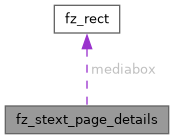
| fz_rect | mediabox |
| int | chapter |
| int | page |
Detailed Description
A note on stext's handling of structure.
A PDF document can contain a structure tree. This gives the structure of a document in its entirety as a tree. e.g.
Tree MCID INDEX
DOC 0 0 TOC 1 0 TOC_ITEM 2 0 TOC_ITEM 3 1 TOC_ITEM 4 2 ... STORY 100 1 SECTION 101 0 HEADING 102 0 SUBSECTION 103 1 PARAGRAPH 104 0 PARAGRAPH 105 1 PARAGRAPH 106 2 SUBSECTION 107 2 PARAGRAPH 108 0 PARAGRAPH 109 1 PARAGRAPH 110 2 ... SECTION 200 1 ...
Each different section of the tree is identified as part of an MCID by a number (this is a slight simplification, but makes the explanation easier).
The PDF document contains markings that say "Entering MCID 0" and "Leaving MCID 0". Any content within that region is therefore identified as appearing in that particular structural region.
This means that content can be sent in the document in a different order to which it appears 'logically' in the tree.
MuPDF converts this tree form into a nested series of calls to begin_structure and end_structure.
For instance, if the document started out with MCID 100, then we'd send: begin_structure("DOC") begin_structure("STORY")
The problem with this is that if we send: begin_structure("DOC") begin_structure("STORY") begin_structure("SECTION") begin_structure("SUBSECTION")
or begin_structure("DOC") begin_structure("STORY") begin_structure("SECTION") begin_structure("HEADING")
How do I know what order the SECTION and HEADING should appear in? Are they even in the same STORY? Or the same DOC?
Accordingly, every begin_structure is accompanied not only with the node type, but with an index. The index is the number of this node within this level of the tree. Hence:
begin_structure("DOC", 0)
begin_structure("STORY", 0)
begin_structure("SECTION", 0)
begin_structure("HEADING", 0)
and begin_structure("DOC", 0) begin_structure("STORY", 0) begin_structure("SECTION", 0) begin_structure("SUBSECTION", 1)
are now unambiguous in their describing of the tree.
MuPDF automatically sends the minimal end_structure/begin_structure pairs to move us between nodes in the tree.
In order to accommodate this information within the structured text data structures an additional block type is used. Previously a "page" was just a list of blocks, either text or images. e.g.
[BLOCK:TEXT] <-> [BLOCK:IMG] <-> [BLOCK:TEXT] <-> [BLOCK:TEXT] ...
We now introduce a new type of block, STRUCT, that turns this into a tree:
[BLOCK:TEXT] <-> [BLOCK:STRUCT(IDX=0)] <-> [BLOCK:TEXT] <-> ... /|\ [STRUCT:TYPE=DOC] <-— | [BLOCK:TEXT] <-> [BLOCK:STRUCT(IDX=0)] <-> [BLOCK:TEXT] <-> ... /|\ [STRUCT:TYPE=STORY] <– | ...
Rather than doing a simple linear traversal of the list to extract the logical data, a caller now has to do a depth-first traversal.
Member Data Documentation
◆ chapter
| int fz_stext_page_details::chapter |
◆ mediabox
| fz_rect fz_stext_page_details::mediabox |
◆ page
| int fz_stext_page_details::page |
The documentation for this struct was generated from the following file:
- /home/docs/checkouts/readthedocs.org/user_builds/mupdf/checkouts/1.28.0/include/mupdf/fitz/structured-text.h